
Our last post described our integration into a comfortable life in Zimbabwe, followed by my tumultuous tenure and eventual demise with CARE Canada. With my usual self-confidence, as unfounded as it may be, I bounced back reasonably quickly and my work took on a wholly different focus.
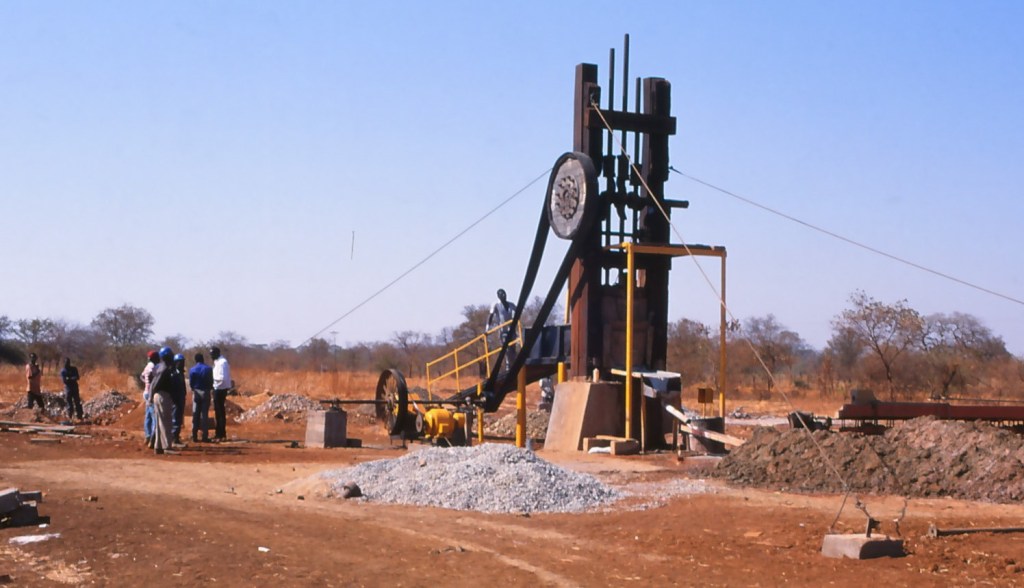
The above is representative of one of the most interesting development initiatives I was involved in, in our 10 years overseas. The photo is of a ‘turn-of-the previous-century-technology’, stamp mill (a 3-stamp in this case) owned by a white farmer who would provide custom milling, a fixed fee per ton of ore milled, to the small scale, black African gold miners. The miners would bring their small quantities of gold bearing ore to these mills, where it would be crushed and the resulting slurry would spill out on to a copper plate, ‘dressed’ in mercury, from where the miner would recover his ‘free’ gold now bound (in amalgam) to the mercury. The discarded ‘fines’ coming off the copper plate, still potentially rich in gold would belong to the farmer. He in turn would recover this gold (called ‘in-solution’)using cyanide solution in a heap leach operation. The resulting relationship between white farmer/mill owner and black miner was typically fractious, fostered distrust and was economically disadvantageous for the miner.
After leaving CARE, I managed to convince a Canadian NGO, the Canadian Cooperative Association (CCA) to hire me to pursue the above project. I somehow secured project funding from the Australian Development Agency. I had a local partner in the Small Scale Miners of Zimbabwe. Giles Munyoro, the President was essentially a one man show, operating out of his chaotic office, dusty rock samples piled everywhere, in a rather sketchy area of town. I hired a couple of young Zimbabwean graduates from the University’s School of Mining ( a metallurgist and a mining engineer) and, lo and behold, we were off to the races.
To make a long story short (I could go on ad infinitum about all the intricacies and challenges we faced), we ended up designing the first cooperatively owned & managed, batch milling plant to serve small scale gold miners in Africa. We first undertook a feasibility study that underlined the many technical, managerial, financial and socio-cultural considerations of making the above a reality. Getting a group of miners together to even consider the possibility of cooperative ownership was a major hurdle. The miners were often illiterate, worked on the edges of legality, were reluctant to reveal details about their respective operations and typically worked their claims at the most basic technical level. Few spoke English and communicating with the miners through my two young graduates posed other challenges. Eventually a couple of capable and respected small scale miners saw the benefit of the concept and were instrumental in bringing others on board. Designing the layout of the plant and the various operational/technical components was a fascinating process. My two technical staff had theoretical knowledge but no practical experience so we relied on technical input from sympathetic white mine owners who knew the locally available equipment and methods most suitable to the output of small scale miners (approx. 5 – 50 tons of ore/month/miner). Even the process of finding a suitable location for the plant, with adequate slope for gravity assisted operations, a secure water supply and centrally located to all the proposed members of the cooperative was a challenge. Not surprisingly, each miner wanted the plant immediately adjacent to his mine! Drawing up a multi-year business plan was another major learning curve, as was the proposed operational plan, staffing considerations, plant management, board structure, profit sharing, etc., etc.. Amazingly, given my totally unrelated work experience and lack of relevant technical knowledge, I was instrumental in pulling it all together – if I don’t say so myself!
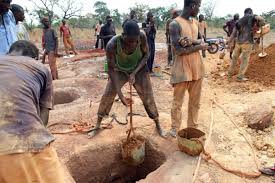
While all the above was happening, I was learning more and more about the small scale African mining sector. I watched as miners, in this case illegal Mozambican migrants, would climb in their bare feet, down hand-dug shafts, using small foot holes in the side of the shaft. Once at the depth of a potentially, gold-bearing alluvial seam (10-20 M down), they would crawl into the unsupported, horizontal shafts, filling buckets with ore that their partner on the surface would pull up hand over hand on a hemp rope. These horizontal shafts were prone to collapse burying the hapless miner where he worked, never to be seen again. Note: The primeval mining I describe above is happening alongside the many well established, modern, large-scale, internationally owned, mining operations in Zimbabwe. For example , BHP, an Australian multinational was operating one of the largest platinum mines in the world in Zimbabwe at the time. The vast differences between the two sectors highlighted the need for support of the small scale, black African miner.
On the periphery of these marginal operations, women miners would pan the fines for gold and then use mercury to create an amalgam with the smallest gold particles, too small to pick out by hand. They would then take the amalgam into their huts so no one could see what they were doing, and more often than not with a young child in a sling on their backs, would burn the mercury off in a frypan over a fire in order to recover the small amount of gold. The resulting mercury vapors are extremely harmful to anyone breathing them. To witness this, was motivation to do an epidemiological study to verify what level of mercury poisoning was occurring amongst artisanal, alluvial, gold miners. I wrote up a proposal and miraculously, given my ignorance of epidemiology, secured funding from the Dutch to undertake the study. (Not sure what this says about the quality of Dutch overseas assistance.) Note: The vital role of mercury in gold recovery resulted in a significant black market in the element. Apparently, keeping the mercury-filled thermometers in hospitals/clinics was a major challenge!
Despite the positive start, the study soon collapsed. We found out that the hair sampling we had proposed in our study could not be analyzed for its mercury content in-country. Blood samples could be tested locally but if you can imagine the difficulties of drawing blood from superstitious, illiterate, illegal-immigrant miners at the height of the AIDS pandemic and you can understand our dilemma. Given these insurmountable obstacles, we pulled the plug on the study.
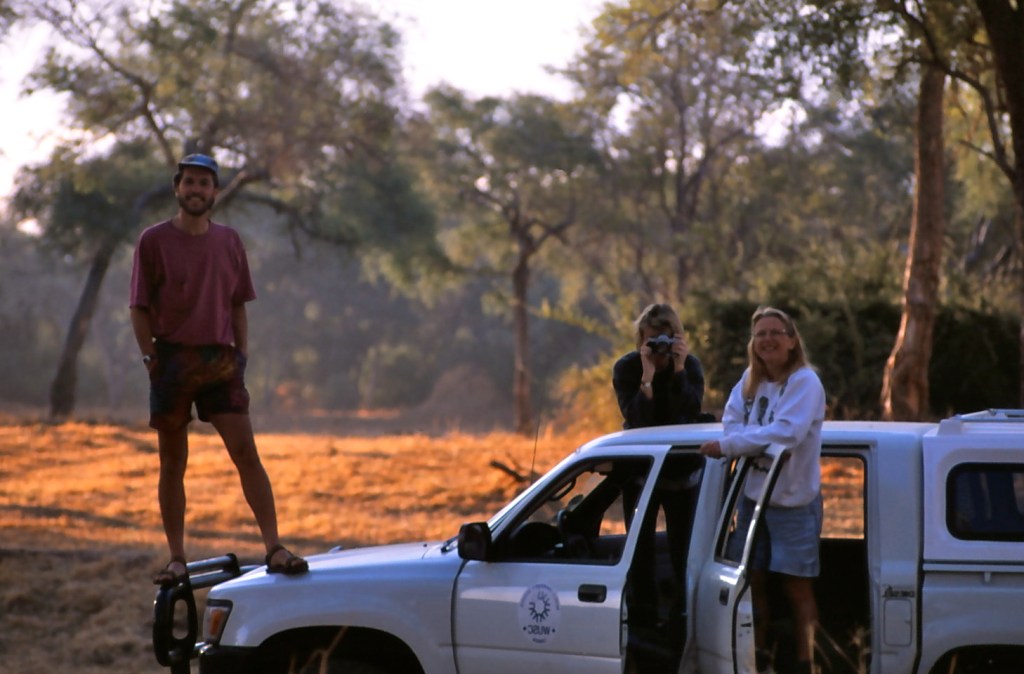
Visiting game parks (aka safaris) was one of the great delights of our almost 7 years in Africa. Over the years, we visited game parks in Kenya, Tanzania, Mozambique, Namibia, Botswana, Swaziland, South Africa and of course, Zimbabwe. The photo above is from Mana Pools, an isolated park in the north of the country, alongside the Zambezi River. Mana Pools was unique in that it was one of the only game parks that we knew of where visitors were allowed out of their vehicles. The principle campground had no perimeter fence allowing elephants, hippos, even cape buffalo to wander through the camp. Much has changed since we were there but Mana Pools, even today remains notable for walking safaris. Of course, these are now led by armed guides. In our day that was not the case, something I never quite understood. It was a wild, remote and undeveloped place. In the above photo, we are with our good friends Greg & Evelyn (we’d left our respective kids at home in Harare with their nannies). I’ve cautiously wandered a short distance away from our vehicle to take the photo with the others reluctant to leave the vehicle. Such caution would be standard practice in all game parks. We visited Mana Pools three times. Once by canoe (see paddling-the-zambezi-and-climbing-kilimanjaro), once with our visiting niece and the above trip with G & E. We’ve had so many wonderful animal encounters and experiences on these trips and other safaris but I’ll just recount a couple of tales from Mana Pools.
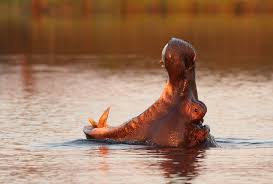
We camped a couple of nights with G & E, each in our respective tents, in the one and only main campground. We sat around a fire at night listening to all the sounds of the African bush. At one point, I left the security of the fire to take a look out over the river. It was a stunning, moon lit view of the Zambezi, a river teeming with wildlife including the continent’s greatest concentration of hippos. I casually strolled back to the fire and then turned around to see an enormous hippo heading for the river, right through the spot I had just been standing. They say never get between a hippo and the water, its refuge. Hippos kill more people (approx. 500/year) than any other animal in Africa, not counting mosquitos (malaria) and poisonous snakes. N.B: My older brother was bitten by a puff adder in Mozambique and suffered serious necrosis at the wound.
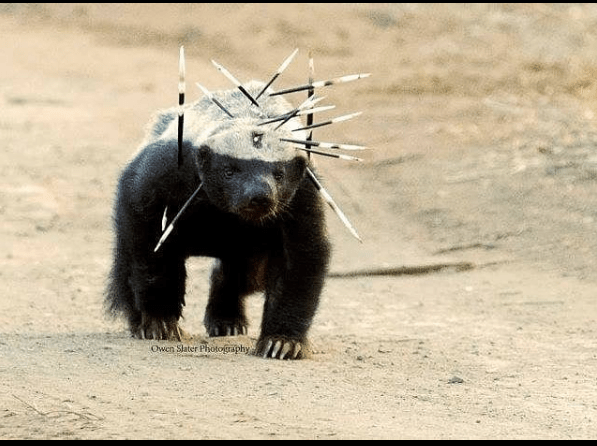
Later that night, we took the canopy off the truck and stashed our cooler under the canopy (exactly what our thinking was at the time I can’t remember. Maybe to use the pick up bed as an animal viewing platform??). A few hours later, we were awoken to a noise coming from under the canopy. Greg and I got out of our respective tents to investigate. An unknown animal had excavated a tunnel under the canopy and was trying to open the lid of the cooler, which kept clunking down in the confined space. We banged on the canopy, and a tough looking, honey badger, the African equivalent of a wolverine, scurried out, ran a few meters then turned around and glared at us. Clad in only our undies and bare feet we quickly backed off. The badger eventually left, we put the cooler in the truck and went back to bed.
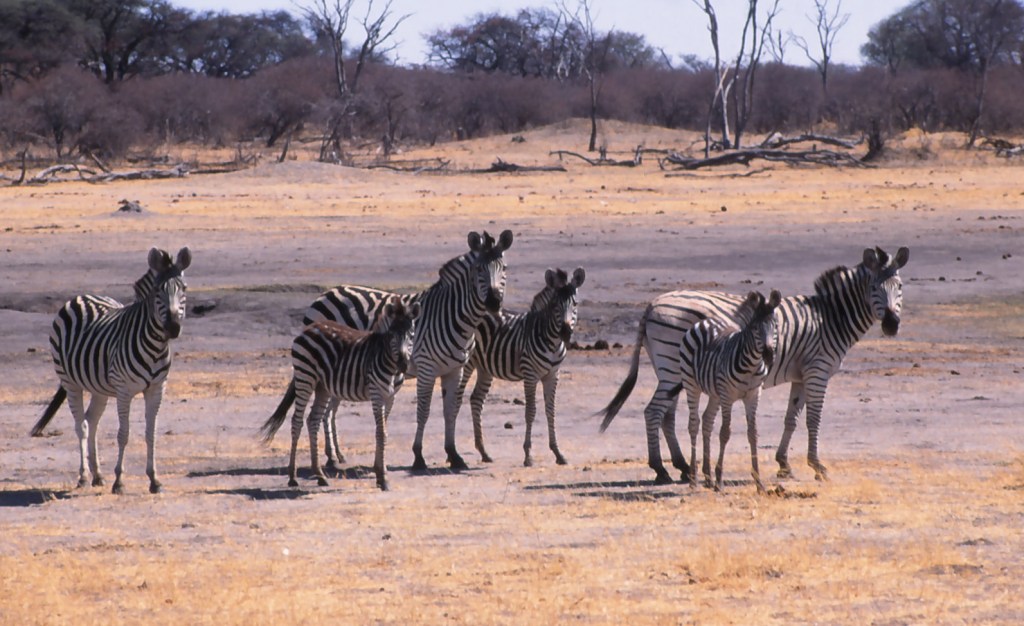
On another visit to Mana Pools , this time with Nina (approx. 1 yr old) and Nathalie (20) from Quebec I made the exceedingly stupid decision to camp at a remote spot on the banks of the river, far from the designated campground. I justified the decision based on my assessment that it was a camping spot used by guided canoe groups (i.e., people who knew what they’re doing!), though I’m pretty sure we were not supposed to be there. I set up our tent close to the steep riverbank and adjacent to a cut in the bank once used as an access points for animals but now seemingly abandoned, blocked with branches. I parked our Toyota HiAce van strategically to create a sort of barrier (a veritable Maginot Line!), gathered enough wood for our evening’s fire and settled in for the night. Nathalie slept in the vehicle. Claire & I on the ground in the tent with Nina between us. Trying to sleep with all the noises, primarily hippos, from the river below was a challenge but we eventually drifted off. Once again, in the middle of the night we awoke to sound of breaking branches from the cut in the bank immediately below us.
With Nina still asleep, we listened , with hearts in mouths as a large, a very large, animal worked its way up the cut, breaking sticks in its path, until at the top and immediately adjacent to our tent, we could feel the presence of this big, living, breathing….something. Desperately hoping that Nina wouldn’t wake up crying, her usual behavior, we remained motionless but no more noise was to be heard. I eventually and cautiously poked my head out the tent but nothing was to be seen in the dark. Whatever it was had silently vanished. The morning light revealed enormous elephant footprints right beside our tent!
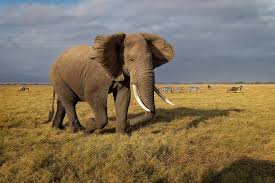
Despite, the heightened sense of insecurity after the night’s event, I convinced Claire that we should go for a bit of a game walk. A well trodden game trail running parallel with the river seemed the obvious choice. With Nina in a backpack we headed upstream. Not more than a few hundreds meters from our camp, we noticed a bull elephant off in the distance that was heading in our general direction. Claire wisely insisted we head back. Once safely back at camp, I grabbed our binoculars and headed off to climb atop a nearby termite mound, from which I could better view the big tusker. Convinced he wasn’t coming our way, I took the opportunity to scan our surroundings for other game.
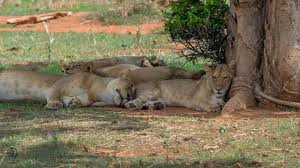
Looking downstream, along the aforementioned game trail, about 100-150 M from our camp and much to my horror, I could make out three lionesses sleeping in the shade of a small bush. I quickly retreated to our camp, informed the girls of our feline neighbors, who quite rightly freaked out and insisted we pack up and get out of there asap! As I pondered the 50/50 possibility of our having chosen to walk downstream, as opposed to up, and what would have been the outcome of three unarmed tourists and a baby, approaching, completely unaware, three sleeping lionesses…I shudder to think. Even now, as I repeat this tale, I get a strange, somewhat nauseous, sensation deep in my gut. I remain ignorant, purposefully so, as to what that outcome might have been.
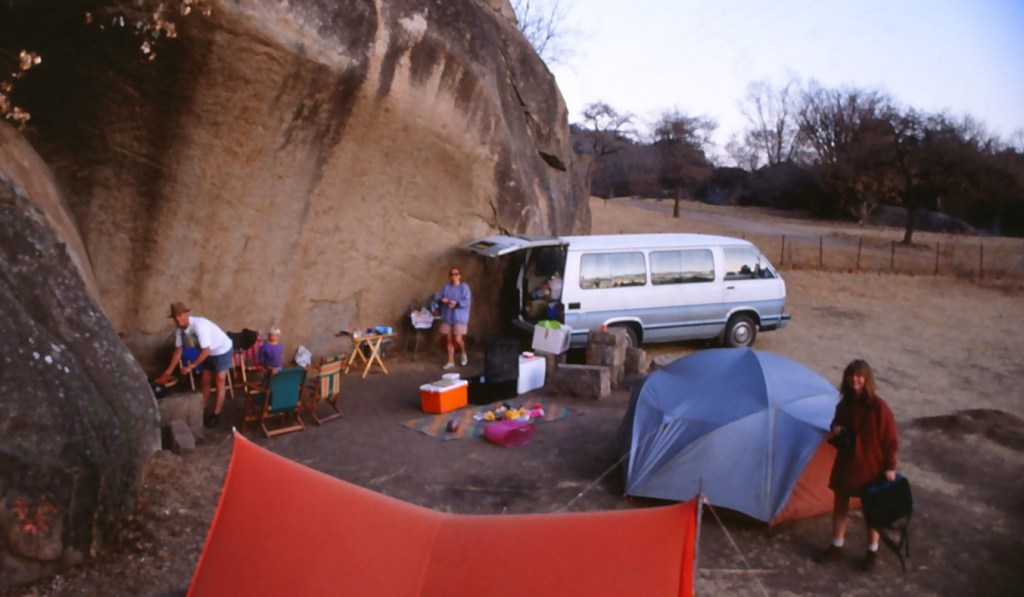
Another camping safari with good friends Mitch and Susan. I think it was the previous night on this trip that I ensured everyone we could camp without the tent fly installed, as it “never rains at this this time of year”. Mitch will never let me forget that midnight scramble to install the fly with the rain coming down. To top off their trip, they got married in our front yard!
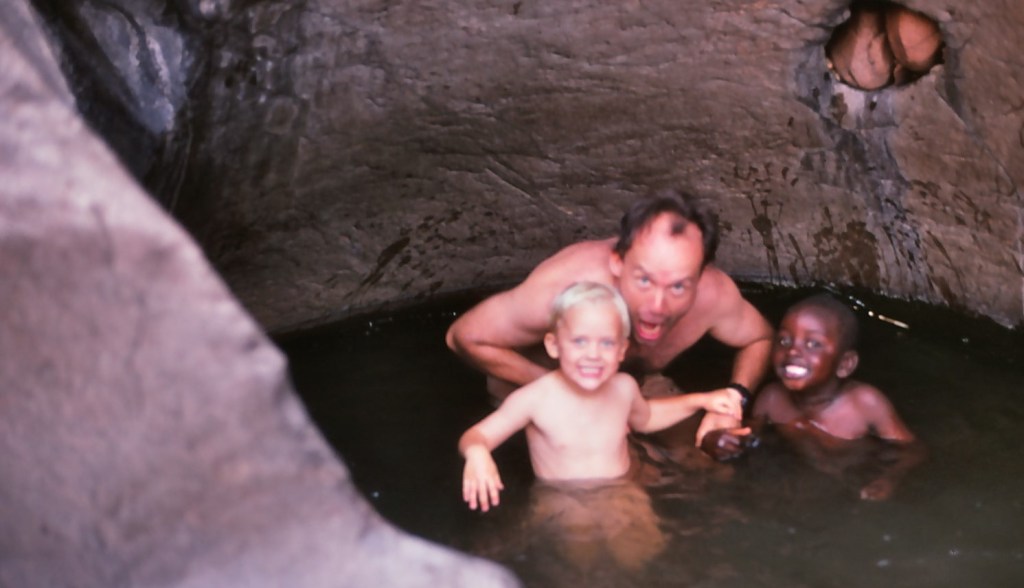
Another of the joys of camping in Zimbabwe was the ability to swim in the lakes and rivers which were free of bilharzia (schistosomiasis), endemic in so much of tropical and sub-tropical Africa. At least, that is what we were led to believe at the time. It is the second most dangerous parasitic virus after malaria (but according to the World Health Organization’s latest data, it is indeed endemic to Zimbabwe…….ooops!).
After almost 3 1/2 years in country we were feeling good. Claire’s work was going well. My cooperative gold milling plant project was moving ahead and family life was great. At the same time we were starting to miss our connection to extended family and friends back home. It was about this time that CCA, my employer, asked me to to return to Ottawa for a conference. Shortly after I left for Canada, Claire went to Immigration to renew our visas. The immigration official disappeared into a back office only to emerge some time later to inform Claire that she had 48 hours to leave the country. This was shocking news for which there was no forewarning. Claire, not one to freak out was now…..freaking out! Refusing to accept this bizarre and inexplicable demand, she returned to Immigration the following day but this time accompanied by the 1st Secretary of the Canadian High Commission (equivalent to our Embassy when in other countries belonging to the Commonwealth). Heather was both a friend and powerful ally in this sort of situation. After lengthy back and forth and calls to higher ups, the time we were allowed to stay in country was extended to two weeks. The High Commission and Claire’s employers, the International School and Peace Corps, all ensured Claire that there was some sort of error and this would all be ironed out.
Meanwhile, I’m in Ottawa, unable to return to Zimbabwe and feeling useless. Claire and I tried to talk everyday but phone connections with Africa were always problematic. After one week with no sign of change on the part of Immigration, Claire felt she had to start putting the logistics of our departure into place. And then things started to get really weird. My Zimbabwean colleagues in the mining project began to figure out what was happening. The Vice President of the Small Scale Miners Association, a man I had never met, never even heard of, was a cousin of President Mugabe. It turns out that he wanted the money I was bringing in from donors to go to his mine. He was behind the effort to get me out of the country! Given the endemic corruption, lack of legal remedies and the connection to the all-powerful President, the Zimbabweans working on the project had to be very careful in what they said or did, from this point onwards.
In an effort to ensure we left the country and hard as it might be to imagine, Claire received crude bomb threats by telephone! At one point, one of the miners, our key ally in convincing others to join the co-op, came to support Claire. While at our home, his car parked out on the street, caught fire! Was it intentionally set or simply an accident, we’ll never know. Another day, when Claire went to Evelyn’s to pick up Nina (on a play date with Evelyn’s daughter), she received a call from a desperate sounding Eva, in tears, claiming that William was drunk and was beating her. Nico was with Eva at the time so Claire rushed home in a panic concerned for his safety. William, stressed about our imminent departure and his uncertain future had started drinking, something we had never witnessed before. By the time Claire got home he was tearfully, apologetic. Claire at this point was stressed, scared and overwhelmed but now even more determined to get out of the country.
All of this was complicated by the need to pack up our lives of 3 1/2 years in less than a week. She needed to quit two jobs, arrange a container to pack our things including a funky living room furniture set that was still off at an upholster, sell a vehicle, terminate a lease, etc. etc. Leaving William and Eva in the hands of the pushy, racist landlady was another stressor, all further complicated by the needs of two children under four years of age and a husband 13,000 kms distant. This is not to mention the sudden abandonment of all the social, recreational and work related aspects of our lives in Zimbabwe. In retrospect, Claire looks back at this period in her life as something akin, at least a little, to the experience of a refugee forced to abandon their country. Throughout it all, the support of our friends Greg and Evelyn were essential in ways Claire will never forget.
To add injury to insult, one last obstacle remained. Claire, now a nervous wreck, headed to the airport overloaded with last minute luggage, Nico in a stroller, Nina clasping her free hand but thankfully accompanied by Heather, the 1st secretary. Once past check-in and free of luggage, Heather unable to continue, waved goodbye and left. Claire proceeded to passport control who promptly insisted she could NOT leave the country because she could not produce the disembarkation/immigration form (remember those) we filled out when she last entered the country. At her wit’s end, Claire dropped the kids and turned around, ran out of the airport and managed to catch Heather as she was about to drive off. Asserting her diplomat status, Heather accompanied Claire back and forcefully insisted on her right to leave which, after much back and forth in Shona amongst assorted officials, was eventually granted . Dread the thought of how this would have played out if Claire hadn’t caught Heather.
I’ll never forget seeing a bedraggled Claire, kids in tow, assorted bags hanging off her, arriving at the Montreal airport. Her long flight to Paris, another long delay at Charles De Gaulle airport and then another 8 hr flight to Canada without any sleep was an exhausting ordeal. Nina, equally frazzled, when she saw me burst out crying.
And so began our new life in Canada. Where to live? What to do for work? This stage in our lives, 10 years of overseas relief and development work, had come to an abrupt end. A new life, so completely different, was to begin.


Loved this, Jim. Very impressed with Claire getting you out of the country. Denise Sent from my iPhone
LikeLike
Thanks Denise. Yes, when push comes to shove, Claire is the tough one on this family!
LikeLike
Why? Why I ask you, why? Why does Claire, why did Claire, ever listen to you? It feels like you actually lived some sort of 3rd world Walter Mitty dream in which you’re a bit of a Homer Simpson who always walks away in the end. And I continually ask you for advice! What is wrong with me?!?
LikeLike
WordPress is stupid. I went back and forth attempting to log in and submit a comment only to be told numerous ways that I failed…
Why? Why I ask you, why? Why does Claire, why did Claire, ever listen to you? It feels like you actually lived some sort of 3rd world Walter Mitty dream in which you’re a bit of a Homer Simpson who always walks away in the end. And I continually ask you for advice! What is wrong with me?!?
Also: what’s up with the honey badger? Are those quills?
Gary
>
LikeLike
So a Walter Mitty character is defined as “an ordinary, often ineffectual person who indulges in fantastic daydreams of personal triumphs”. I beg to differ, at least a little and don’t get me started on “What is wrong with me?!” I could go on.
As for Claire listening to me, she now takes everything I say with a big grain of salt. As for problems with WordPress, I think it is operator error!
And yes, those are porcupine quills! They are tough as nails, every bit the equal of wolverines!
LikeLike
How did I survive….. you guys must be on your last lives.
LikeLike
And now your son works in the mining industry!
LikeLike
Not exactly following in your father’s footsteps….but close enough!
LikeLike
(This comment is from Sylvia, a friend and also the wife of Art Wright, the High Commissioner while we were in Zimbabwe. She had trouble figuring out how to comment. Apparently, she’s not the only one!)
I now understand why Art was so silent about the situation. He had told me only that you had gone back to Canada, then many days later he let me know Claire was leaving but no details on the circumstances. I am certain that Mugabe’s henchmen had made it clear that you had been kicked out, forbidden to return and that Claire was included. Being circumspect as a High Commissioner is not always easy and because we were friends and had shared friends he was following orders from the governments of both Zimbabwe and Canada in terms of your personal safety. I heard nothing at all from Greg, Evelyne or anyone else so it is all news to me. I vaguely remember Art mentioning problems with your gold extraction process. I was upset so he encouraged me to visit Claire before she left so it was a short and tight-lipped trip and I remember how upset and confused she was.
My first and vivid memory is of you greeting us on top of a hill, a grassy knoll somewhere in Harare where I think CUSO may have had a office. There were a lot of welcome parties when we first arrived, I think largely because Charles Basset had done such a good job in handling the PM’s visit and people were very pleased with themselves.
Hugs to you both!
LikeLike