
This blog post is, in some small way, prompted by the refugee crises impacting so much of the world. The current, tragic situation in Gaza (Oct/23-May/24) has been especially triggering for Claire. Accordingly, she wishes to share a bit about her past work with refugees traumatized by war.
Long before she met Jim, Claire was an adventurous soul. At age 19 and shortly after finishing CEGEP in the small town she grew up in (Victoriaville, Quebec), she fled her domineering father and the limited future her parents envisaged for her. The next five years were a period of learning about the wider world, self-discovery and inadvertently, lots of adventure, culminating in her work with the International Red Cross on the Cambodian border. Unlike Jim, Claire is understated and much less likely to ramble on about her past accomplishments and adventures. So, with a little encouragement from Jim, this is her story:
Growing up I often thought of becoming a doctor but a lack of resources and in those days, a lack of self-confidence, led me to do a three year, Certificate in Nursing as part of my CEGEP. It was also, in my mind, the fastest way to gain the financial independence required to leave what I saw as a limited future in my home town. So, shortly after graduating I moved to Quebec City and started work as a neo-natal ICU nurse. After maybe a year and half in that lovely town, I was ready for something new, so I moved to Switzerland and got a job, also neo-natal ICU nursing, at a hospital in Lausanne. Despite the many joys of living in beautiful Switzerland with wonderful, short-hop, travel opportunities in every direction, work in the conservative, physician-dominated atmosphere of a Swiss hospital, grated on my burgeoning emancipation and contrasted with the more relaxed, collegial atmosphere I was accustomed to in Quebec. So, after a year in Lausanne, I backpacked Europe for a while then headed to Senegal for an eye-opening travel experience. At the time, I thought I would never be able to work in Africa. Little did I know that I would later live and work in Africa for seven years. I then went back to Canada where I landed another neo-natal position at a hospital in Ottawa. This was also an opportunity to improve my English, which at the time was quite limited, and to take some courses towards a Bachelor’s Degree In Nursing. Despite the work load I remained restless. I wasn’t sure why, or what I was looking for but my new found interest in travel and discovering the wider world had taken hold
So when I heard that the Canadian Red Cross was recruiting medical staff to work on the border of Kampuchea (Cambodia) and Thailand, I applied. My limited nursing experience at that point, neonatology and pediatric ER, all within highly structured hospital environments, was hardly preparation for ad hoc, field nursing in the rudimentary conditions of refugee camps with a traumatized population. Despite this lack of relevant experience (they wanted 10 years), they hired me as I was ‘bilingual’. A bit of a stretch, but I wasn’t about to dispel the notion.
Despite promises to my boss to the contrary, I quit my job in Ottawa and soon (July,1980) found myself in Toronto as part of a small team (two logisticians, two doctors, an anesthetist and three nurses) being briefed by the Canadian Red Cross for an upcoming relief mission with the International Committee of the Red Cross (ICRC) to one of the large refugee camps on the border between Cambodia and Thailand. As the instructor briefed us on the volatile military situation, the ubiquitous landmines, the conditions in the camps and all the attendant security measures, I thought ‘what have I got myself into’. I was young (24 years old), inexperienced and quite frankly, nervous.
Most of you will remember hearing about the horror that was the Cambodian genocide during the reign of the Khmer Rouge (1976 -79). The tragic and convoluted history of Cambodia in the 20th century is hard to get one’s head around but, as they say, “who doesn’t learn from history is doomed to repeat it”, so I tried to write a short recap of the past 80 years in that country. I gave up. It’s too complicated, tumultuous and with too many players. Suffice it to say, that it was the destabilization of the region brought on by the Vietnam War (locally referred to as the American War), the malign influence of neighboring countries, the ‘secret’ US bombing campaign of eastern Cambodia and the fragile, often corrupt, political situation that led to the conditions that facilitated the rise of the Khmer Rouge. Even today, though constitutionally a multi-party state, Cambodia is now a de facto one-party state ruled by a dictator. Sadly, if the past is any indication, and despite the seeming stability of recent times, Cambodia’s future remains uncertain.
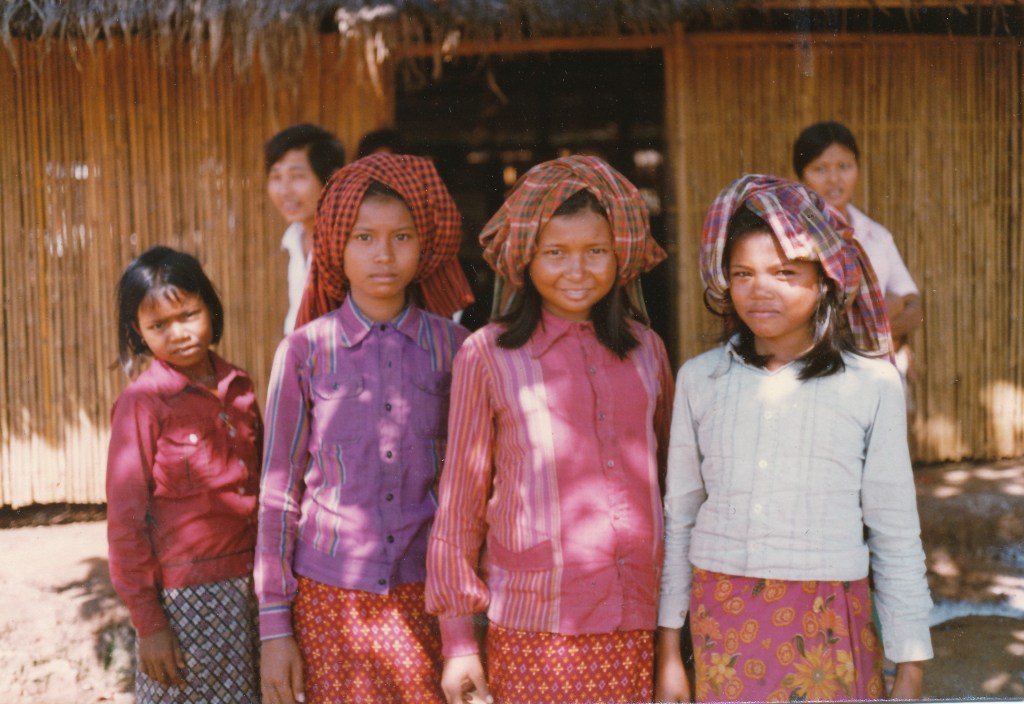
Most relevant to my experience, is that 4 year period of the KR, under the leadership of the infamous Pol Pot and his efforts to create an entirely self-sufficient, agrarian, socialist society. To fulfill its goals, the Khmer Rouge emptied the cities and forced Cambodians to relocate to labor camps in the countryside, where mass executions, forced labour, physical abuse, malnutrition and disease were rampant. Most estimates are that two million people (25% of the population) died during this short, still difficult to comprehend, period. With the Vietnamese invasion in 1978 and subsequent collapse of the KR regime, a massive flow of refugees fled towards the safety of Thailand. By the end of 1979, about 750,000 Cambodians were believed to be either in Thailand, in the border camps, or near the border attempting to cross into Thailand. The Thai army was very aggressive and did everything in their power to prevent refugees from crossing the border. In their effort to flee, many perished in the heavily mined border region. Note: The 1984 film The Killing Fields and the book, The Quality of Mercy by William Shawcross are both excellent accounts of this horrific period in modern history.

After a comprehensive 3 day orientation in Toronto covering the Red Cross itself (mission, values, objectives) and our specific task to assist the refugees in the Thai-Cambodia border camps. The ICRC’s mandate is to protect victims of international and internal armed conflicts as opposed to the role of Red Cross and Red Crescent Societies, which is to provide relief in the case of natural disasters. My assignment was to work as a public health nurse in a team that included an American and a Dutch nurse, both of whom had way more experience than me.
Those three months of my first posting with the Red Cross were truly unforgettable. Despite my lack of experience, I somehow managed to ‘wing it’ (something I’ve been doing all my life)and performed my duties to a level acceptable to both the need and my employer. I got along with and worked well with my international colleagues. Most importantly, I really enjoyed working with the Khmer staff and felt I connected well with the refugees.
It’s funny the things one remembers from that time. Stuck in my brain is the the flip flop sound of the Khmers walking in sandals. Everyday, the children of the camp would welcome us and send us home with “hello” and “bye-bye” and their unforgettable smiles. Some of the newborns were even named Bye-bye. As I said before, the refugees were unfailingly friendly, kind and, despite the desperate situation they were in, amazingly never complaining. I don’t remember ever seeing an outward display of anger or even frustration. I think many of us secretly wanted to take some of the orphans home with us. Some international workers managed to smuggle some Khmers in the Red Cross ambulance out of the camps to a better equipped hospital on the Thai side. This ‘operation’ was eventually uncovered and the Thai army guarding the border became much more hostile towards us.
Our team was assigned to Nong Chan, a refugee camp of 15,000 individuals. We worked 6 days on then one day off, with a bit longer break at the end of each month.

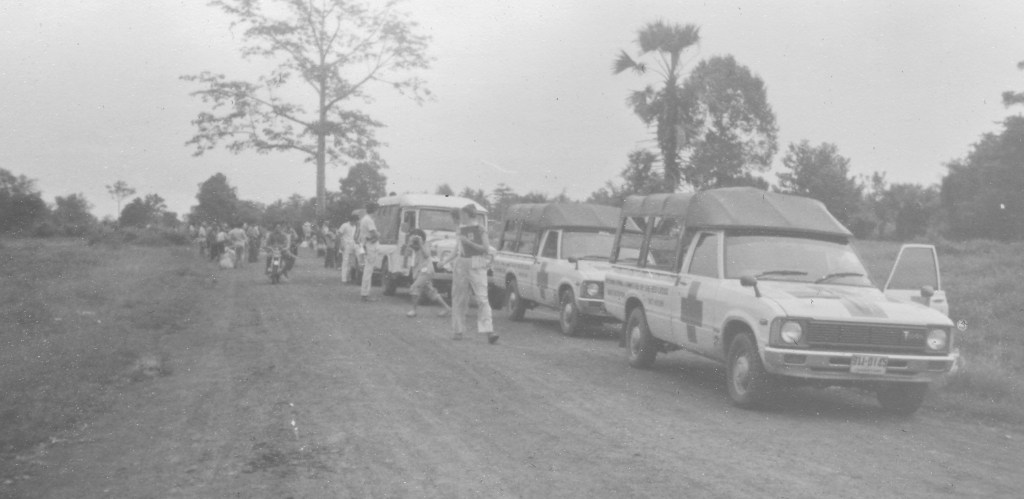
Each morning, we drove our truck to a warehouse to pick up supplies for the day, made sure that our radios were working then drove as a convoy with a big Red Cross flag on the side of the truck to a designated site. Once there, we waited for a ‘green light’ that came from our Chief Delegate, ensuring the camps were safe – neither infiltrated by KR forces or under attack by Vietnamese troops – so that we could cross the Thai border and enter the camps.

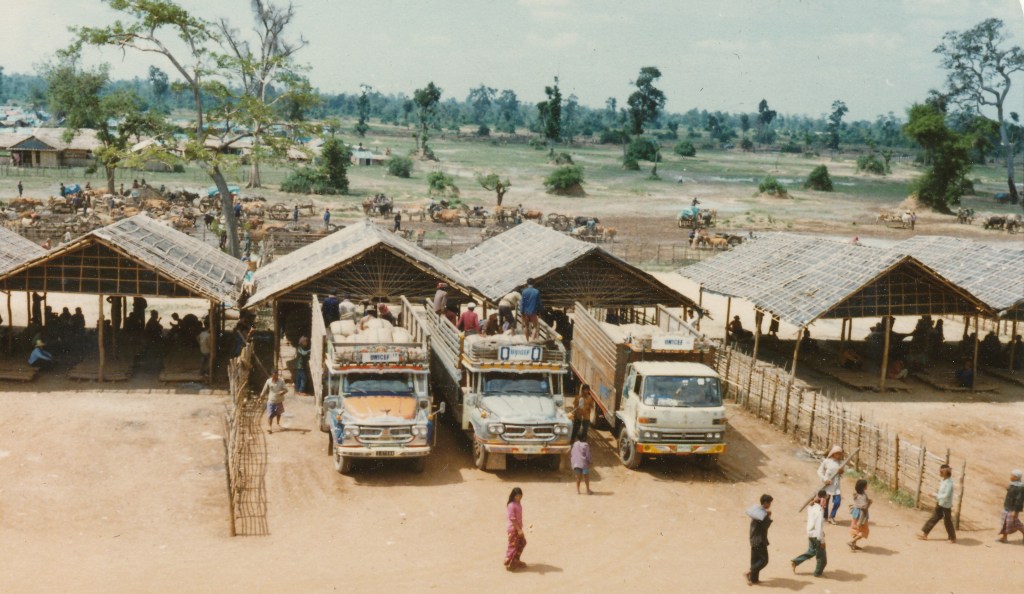
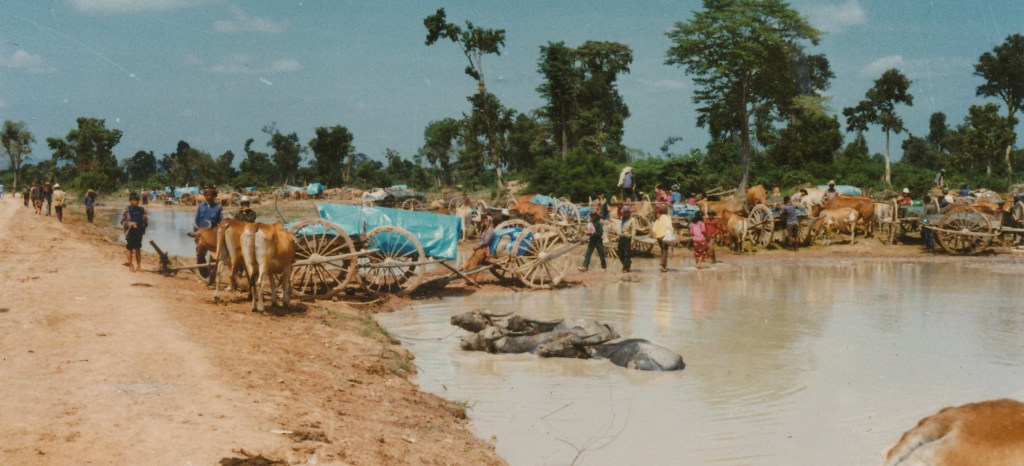
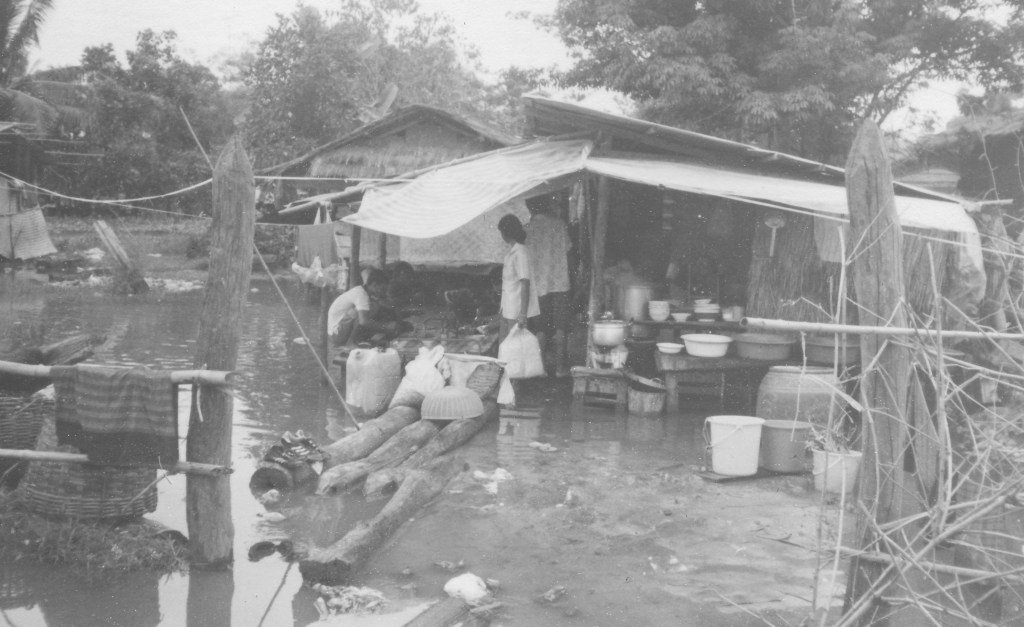
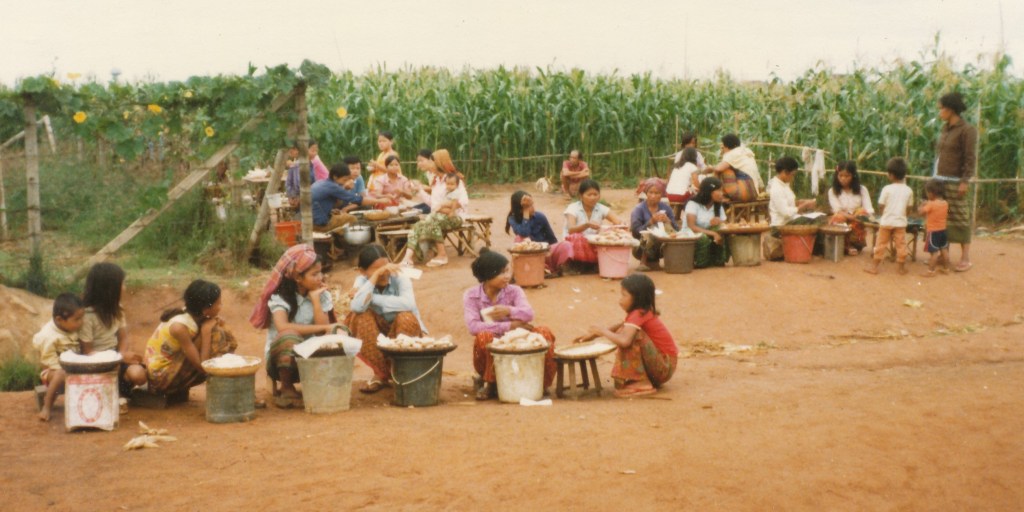
Nong Chan served not only its residents but also the ‘travelers’. These were Khmers who still lived in Cambodia but came for food and seed distributions, most of which was managed by CARE, the international NGO. Once a month, there was a distribution of food for the ‘walking travelers’ and then another for the ‘oxcarts travelers’. The day the oxcarts came was an impressive sight. Thousands (I seem to remember the number 30,000 ??)of oxcarts attended the distribution in a very orderly fashion. It was during the rainy season and the carts picked up mud as they traveled. The road out of camp was noticeably lower once they’d left. The UNICEF logistician who organized the distribution was very good and well respected.
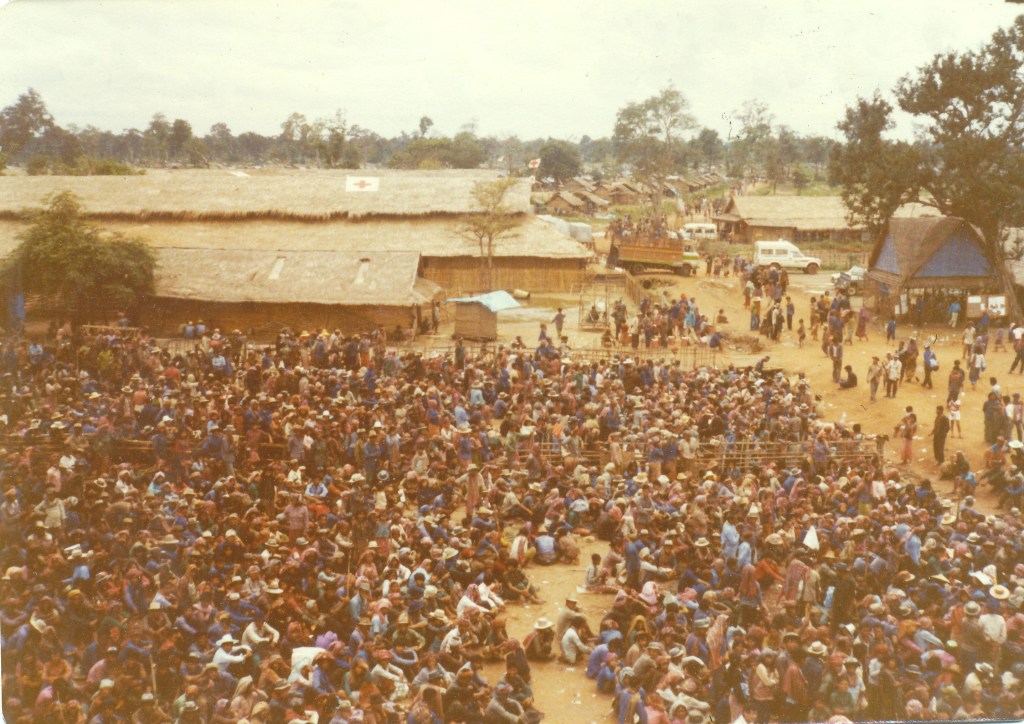

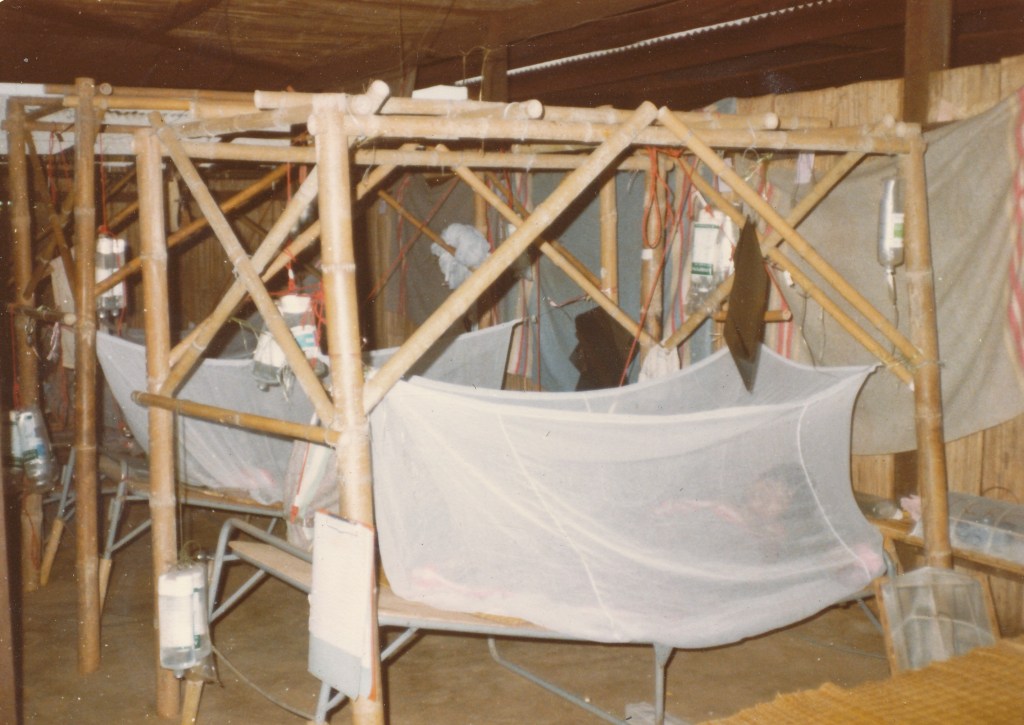
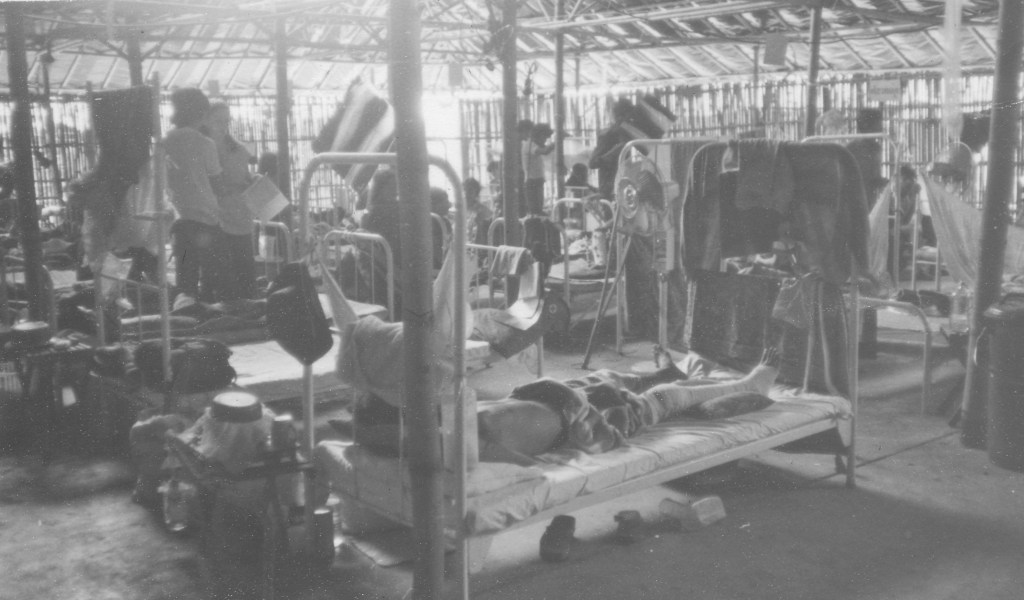
Nong Chan camp had a simple hospital (built all in bamboo) with surgery, pediatric and obstetric services. There was also a nutritional center for children. Several other international and local organizations worked in the camps providing different services such as rehabilitation, prosthetics, food distribution, traditional medicine, etc.


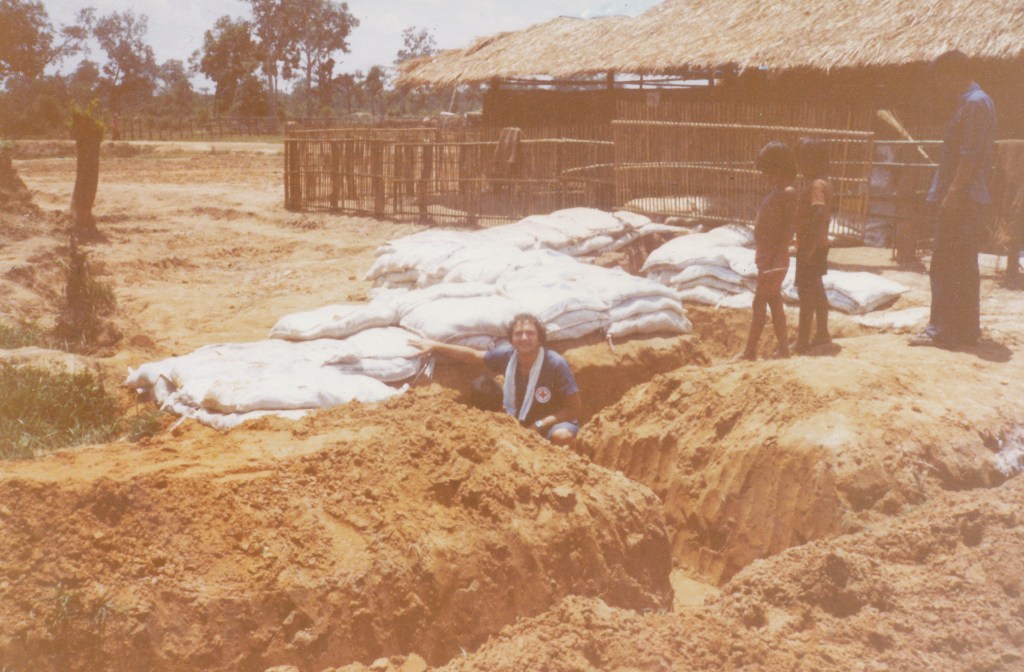

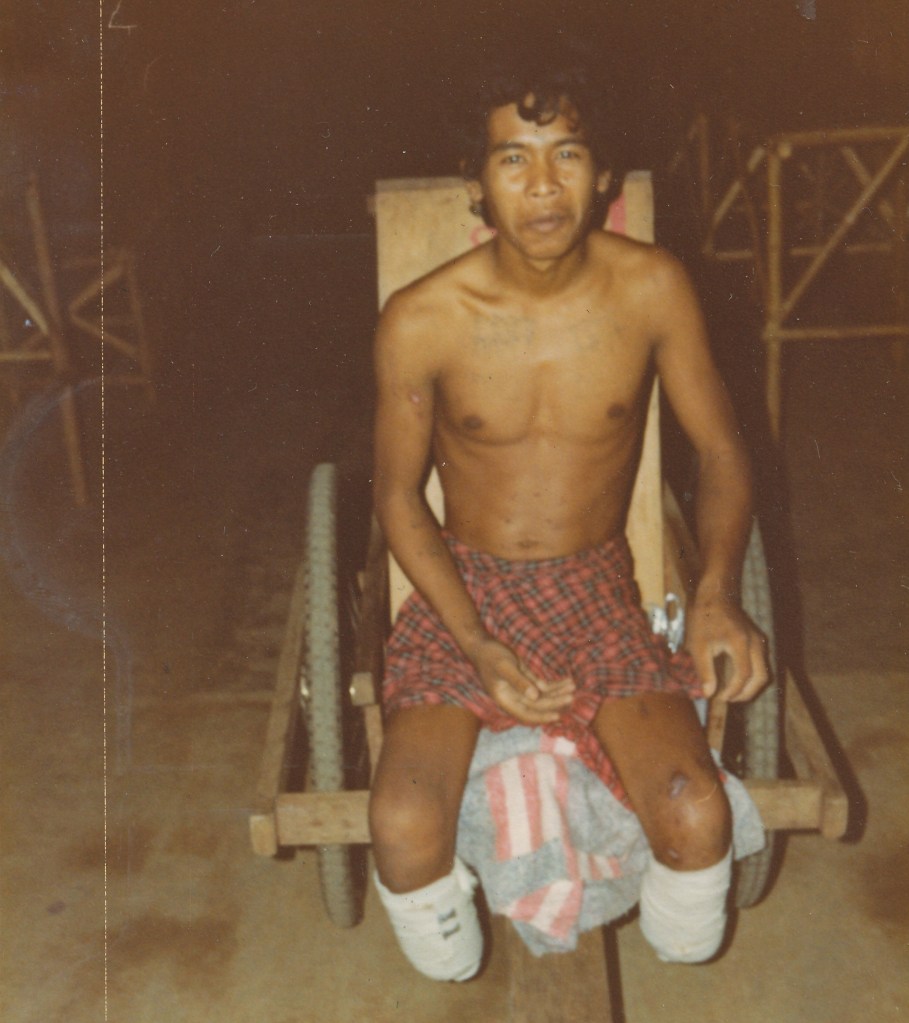
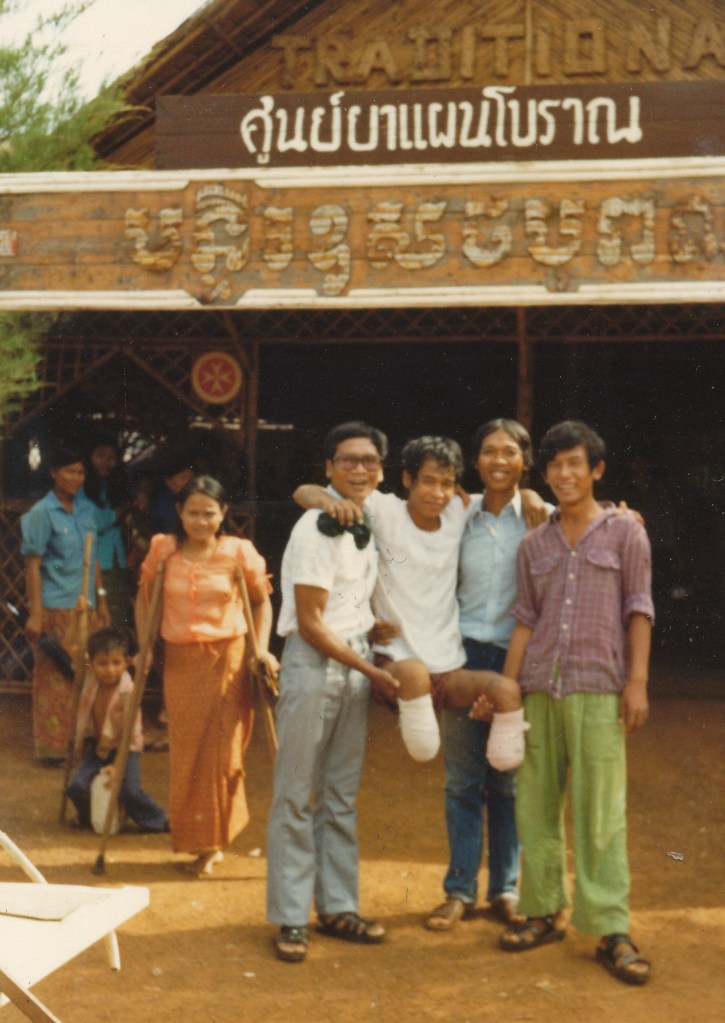



After finishing my three month contract, but while still in Bangkok (preparing to visit Nepal), the Canadian Red Cross offered me another posting. I had a couple of weeks to return home, visit my folks and then meet a new team in Toronto, which, BTW, included a nurse from BC who, unbeknownst to me at the time, would a few years later become my sister-in-law. This time it was a six month posting, working with the League of Red Cross and Red Crescent Societies in refugee camps in Djibouti (on the ‘Horn of Africa’), working with a drought-impacted population of nomadic herders in truly desperate straights – a story for another time. I left that difficult posting quite exhausted emotionally and returned to Canada for some much needed rest. I applied for some courses, one in midwifery in England and another in tropical medicine in Belgium. A colleague from the Red Cross encouraged tropical medicine so off I went to Antwerp. The course was an intensive six months and upon graduation I felt more prepared for ongoing international relief work. Within weeks of leaving Antwerp I was offered another posting and soon after returned to the border camps. This time, I would be working as a surgical nurse (once again, with questionable qualifications)! The posting was for three months and I worked in Khao I Dang, another large camp but more established with better facilities and resources to attend to the injured.
One last tale. Jim and I lived and worked in Zimbabwe for over three years. When Jim was home in Canada on a conference, we were, without warning, given 24 hours to leave the country – a complex story involving a corrupt businessman and, much to his advantage, also a cousin to President Mugabe, who wanted to control our project funds, that ostensibly Jim controlled. This character orchestrated the situation wherein we could not get our visas renewed. To make a long story short, I had to pack up our lives of 3+ years, by myself, in short order, with two kids under four years of age and head to the airport, loaded down with baggage. Last minute border control issues compounded an incredibly stressful time but we boarded our plane in the nick of time and headed for Paris. I tell this tale to highlight how, despite our enormous privilege, resources and connections, that I felt, just a wee bit, like a refugee forced to flee my home. To fully understand the feelings/emotions/mental state of a true refugee is quite another thing. My thoughts are with the people of Gaza, Ukraine, Syria and the many other unstable and unsafe countries around our world! We are so lucky.
 OVER THE HILL AND BEYOND
Gosh, Claire, I always knew you were an exceptional human!
I’m SO glad Jim persuaded you to write about your adventures as a very young nurse, in so many places, under perilous and challenging circumstances.
Amazing work you have done, with wonderful spirit.
Well done, Claire!
Ros Irving
LikeLike
Gosh Rosalind you are a quick reader!! Thanks ☺️ for the compliments but Jim helped massively with the writing. I have struggled with putting this out in the public. It’s not like me… but then I am also the type to take risks so there it is.
LikeLiked by 1 person
very good to read your account of the time in Cambodia and really great to see your photos. Love Char xxx
LikeLiked by 1 person
love you Claire! You are so compassionate and humble! I miss seeing you……but just knowing how you continue to inspire others makes my heart full. As we ski at Rusutsu, this post enforces how fortunate we are to be born into countries that keep us safe, even with the imagined struggles, and that nothing compares to what war and poverty do. I pray that humanity will be better.
LikeLike
That is so kind Susan, Thank you. You also have a big heart and I am happy to know you. I am very glad to see my friends enjoy their retirements and life. I do wish the world was more sympathetic to the plight of the poor though. I was privileged to have worked with them and I often feel I learnt more from them than they from me. Hugs to you and Daryl.
LikeLike
My very amazing friends,, I
LikeLike
What can I say Lorraine, your comment did not come through! But I think I know what you were about to say. You are beyond complimentary. I will send you a text to try to help out with the technology challenges. Cheers
LikeLike
So terribly sorry to say that I cannot seem able to bring down your email on Cambodia which I would dearly love to read. If you know any tricks to make this happen, please advise. This old lady, I am afraid, is truly “over the hill” t 95!
Love and hugs, The old lady (aka your wicked stepmother!)
XXX000
LikeLike
That’s strange Alice. You managed to comment (above) directly on the site, so not sure why you can’t find the post. I’ll send you another email explaining how to view the post.
Love
Jim
LikeLike
Merci Claire et Jim de partager cette expérience avec nous. J’apprécierais certainement lire les autres expériences. Via les expériences de vie, on comprend que certaines de celles-ci se comprennent avec la tête mais d’autres se vivent et que ces dernières sont vraiment saisies dans toutes les dimensions de l’être humain uniquement via le vécu. Claire, tu as été une inspiration quand j’étais dans mon adolescence et ces voyages ”au loin”, qui représentaient la liberté dans ma tête de jeune fille de 12 à 17 ans, m’ont donné espoir et m’ont soutenu. Je me rappelle encore les quelques lettres que nous avons échangés. Merci du fond du coeur. Nicole XXX
LikeLike
Ma très chère petite grande soeur. Je suis heureuse que mes expériences ont servi à d’autres. La vie m’a été très généreuse quand je vois ce que d’autres doivent souffrir. J’en dois beaucoup à mon compagnon de vie qui m’a toujours encouragé et qui continue avec ces blogs. Alors oui, il y aura d’autres épisodes. Avec beaucoup d’amour. XXX
LikeLike
Very interesting post Claire. Well done. You must have written journals to remember all these details. The pictures sure bring back my memories of that time on the border. I like the way you ended your piece with acknowledment of the other horrific conflict zones around the world.
LikeLike
Thanks Ella. I did have the big help of my ‘ghost writer’… I did keep a journal and had notes behind photos as well. Similar to you I would imagine. Does it not seem like ages ago and yet, it is happening all over again somewhere else. How can this world agree to have no war? I think mother earth will be the one to teach everyone to behave. It might cost us a lot!!
LikeLike
A very uncertain world we live in. I’m ‘glad’ we had those front line experiences when we did. Witnessing the uncertainty of the Cambodian refugees lives, deeply marked me. I evrn wrote a book about it! E x
LikeLike
That was a great article – and costume. I was wondering if you’d stayed in contact with the Khmer guy who was so happy to see you because it meant you hadn’t given up on them? That was a life altering moment for him I think.
LikeLike
Uh! There was no email or internet in those days Gary. Nor was there post office in the camps! One Cambodian who eventually made his way to Toronto reached out at some point and we met sometimes in 1981 or 1982… He did not stay in touch after that.
LikeLike
Incredible piece. Sharing my reflection: https://thedumalady.wordpress.com/2024/03/30/mysterious-myanmar-part-2-no-mud-no-lotus/
LikeLike