
I had started this blog post on the Greek Island of Kalymnos with the intention of publishing shortly after our return to Canada. A bout of Covid, caught on the long flight home, and then the demoralizing results of the US election have put a damper on things leaving little energy for writing, but as they say ‘stay calm and carry on’…….. so here it is.
Kalymnos has become one of the most popular, sport climbing destinations in the world. This smallish island in the Aegean Sea and not far from the Turkish coast, is now teeming with climbers from around the globe and has over 4000 established ‘sport’ (i.e., bolted) climbs. Though climbing on the island only goes back 30 years, the local guidebook needs revising most every year as new routes continue to be developed.
The local limestone is very different from the granite of home. Incredibly featured, often very sharp and typically steep (famously overhanging in giant cave formations) we were initially less than confident. Nonetheless we soon adapted, explored different areas every day and quickly recognized what an exceptional climbing destination it is.
Combined with the endless sunshine, daily swims in the Mediterranean, good food, friendly locals and great hikes all made for an excellent climbing trip! But more on Kalymnos later.
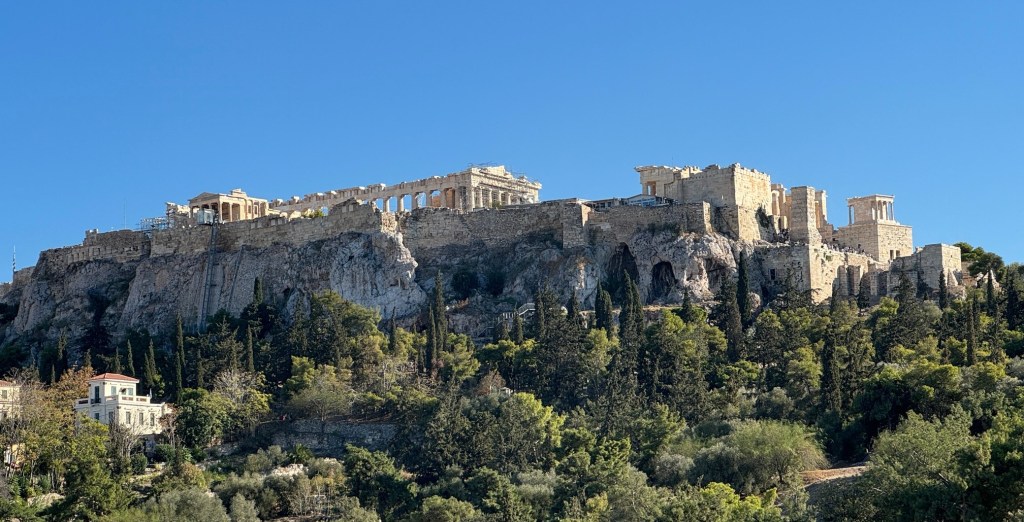
The stellar view of the Acropolis and Parthenon from the balcony of our 1-star hotel in Athens was made somewhat less appealing by the noisy, party street, five floors below. Oh well, you get what you pay for! Recovering from jetlag gets progressively more difficult as one ages so a few days in Athens prior to moving on to Kalymnos were appreciated. A visit to the Acropolis however was a bit of a letdown. The ruins are much diminished and the crowds excessive. We soon understood and emphasized with Greek demands for the return of the Elgin Marbles from the British Museum.
But first a little history. Our climbing life together started five years ago. Claire was recently retired and out of the blue expressed an interest in trying out climbing. For forty years she has been listening to my tales of climbing adventures as a young man. My earlier climbing ‘career’, for what it’s worth was relatively short lived. I was more of a weekend warrior than the dedicated ‘dirtbag climber’ I aspired to be. Making a living got in the way. Nonetheless the sport has always held a special place in my imagination and memory, so when Claire suggested we try it out, I agreed in a heartbeat. It’s not everyday that one’s 63 year old wife decides to take up rock climbing and I wasn’t about to let the opportunity pass.
We started at the local indoor gym that first winter and progressed to climbing outdoors, primarily top-roping (the safest form of climbing), the following summer. Before long, I borrowed some gear, refreshed some of my skills via YouTube (a questionable practice) and we started leading some of the easier routes in the Smoke Bluffs, Canada’s busiest climbing area. Our shared interest, I dare say passion, for the sport was such that we soon committed to fully equipping ourselves, learning more and developing our skills. We are now typically climbing four times per week in season. We’ve learnt tons, made mistakes, had a few close calls and had many wonderful adventures. The sport is so engaging…with the weather, the rock, your partner, your body, the complex technical considerations and, of course, the beautiful nature and often dramatic landscapes intrinsic to the activity. We are feeling so blessed to live where we do, to have our health and to share this interest in such a fun, challenging and rewarding activity.
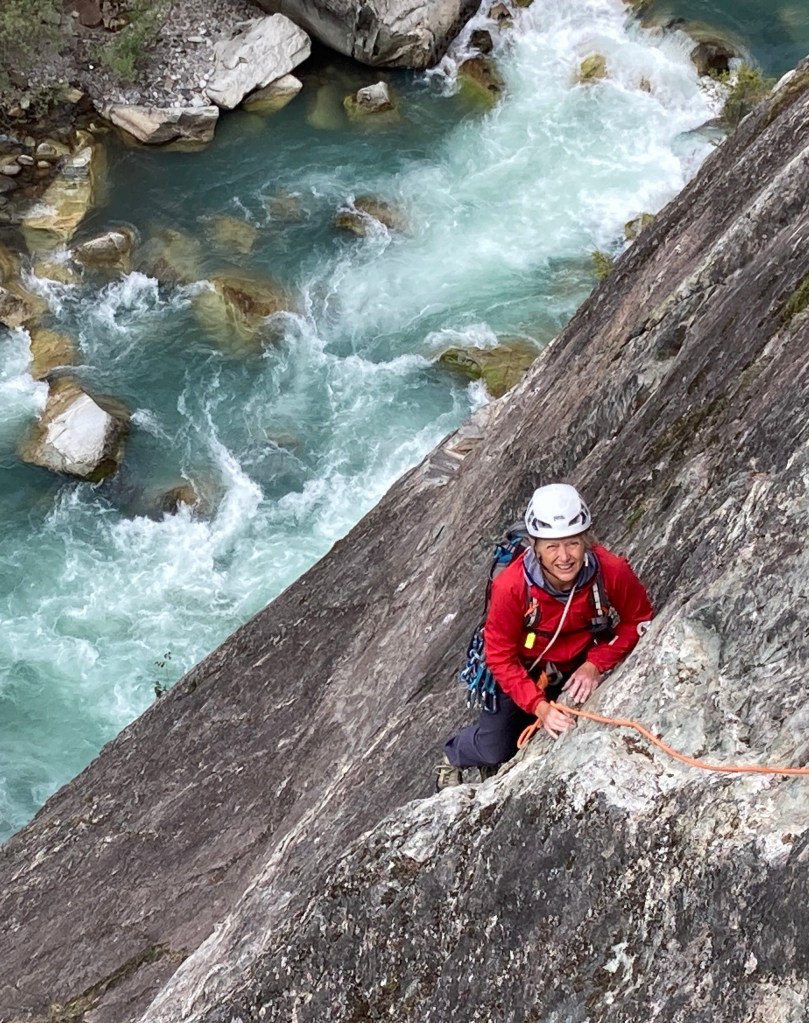
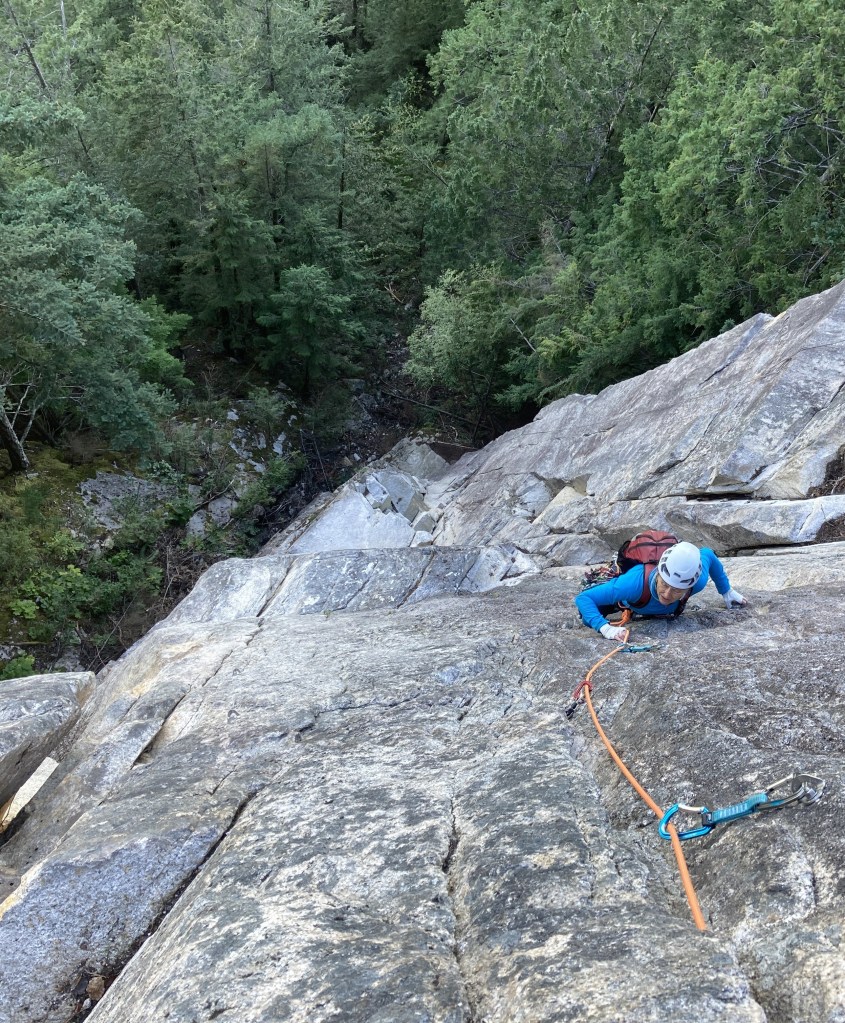
A couple of standout climbs from this past summer: Both newly developed, multi-pitch climbs that were challenging (for us) and super aesthetic. On the left, Indra’s Net (5 pitch, 5.9, ‘sport’ climb) in the Cheakamus Canyon is sure to become a classic. Sustained climbing for the grade and awesome position high above the river. On the right , Adventure Cats (6 pitch, 5.9 ‘trad’ climb) is just south of Squamish and a 20 minute hike into the base. Steep crack climbing with some airy lateral moves with not a soul about made for an adventurous climb. Our climbing photos are an afterthought and it shows. Pulling out one’s phone while on a climb poses a safety risk and I also worry about pulling some klutzy move and dropping my phone, so good climbing photos from us are few and far between.
And mistakes we’ve made. For better or worse, I’ve been Claire’s guide/teacher and I’ve largely relied on skills learnt four decades ago, when gear was different and safety less of the focus it is today. Early on I remember taking a snap of Claire just about to do her first rappel off a small cliff in the Bluffs. She posted the image to FB and was immediately chastened by more knowledgeable friends, for not using a ‘third hand’. This is now a standard safety technique that I had never even heard of. More recently, on another climb, a new multi-pitch (12 pitches, 5.9), high and remote in the local mountains I thought I was using the proscribed 60 M rope length. When rappelling the route, I came up short on one of the rappel stations that led to some very sketchy moves that I never want to repeat. It turns out my old rope was only 55 M, a common length from ‘back in the day’. I measured it when we got home and immediately ‘retired’ it, something I should have done long ago. On other climbs, we’ve got ‘off route’, requiring scary down climbs. On others, poor rope handling has lead to tangled, twisted messes that take forever to suss out mid-climb. And I could go on.
Five years in however, we’ve learnt lots and we make a pretty solid team unlikely to make the mistakes of the past. We’ve got our systems down and we climb efficiently, an important safety consideration when time can be critical. An important lesson however and sometimes hard to accept, is that despite the amount we climb and exercise, our climbing seems to have plateaued. Getting stronger as we both approach 70 just doesn’t seem to be in the cards. The nature of the sport and especially for competitive people like myself and surpisingly, Claire included, the desire to ‘push one’s grades’ (do harder climbs) is always there. If I could comfortably lead one grade higher (5.10a trad) it would open up a wealth of new climbs in the Squamish area, but instead of speculating on unlikely scenarios, let’s get back to Kalymnos.
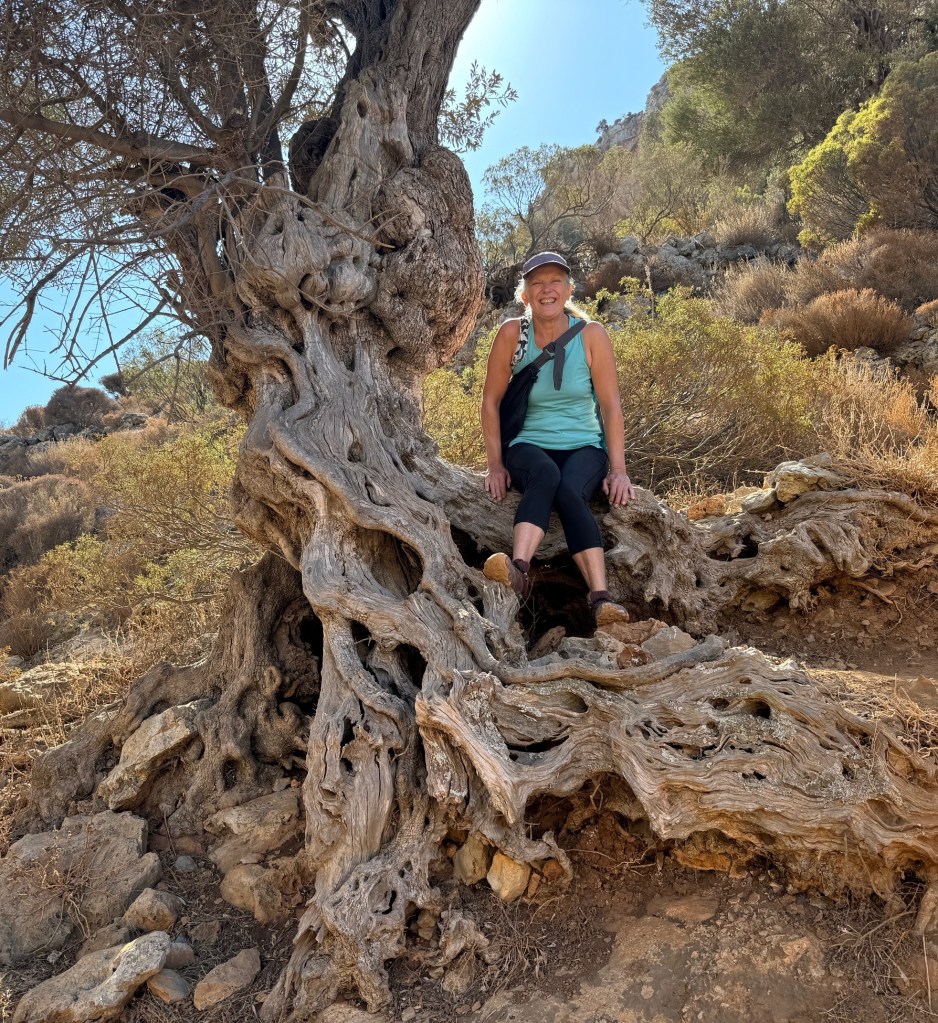
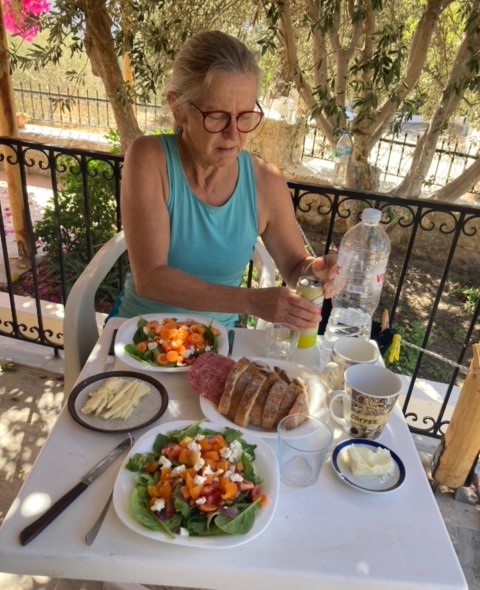
The ancient olive trees of the Arginonta Valley (this was young compared to some). Our little suite had a lovely patio covered by an olive tree draped in bougainvillea in full bloom. Accordingly, we typically ate at ‘home’. Our regular dinner fare, some variation of Greek Salad (while in Rome, do as the Romans) never got tiring.
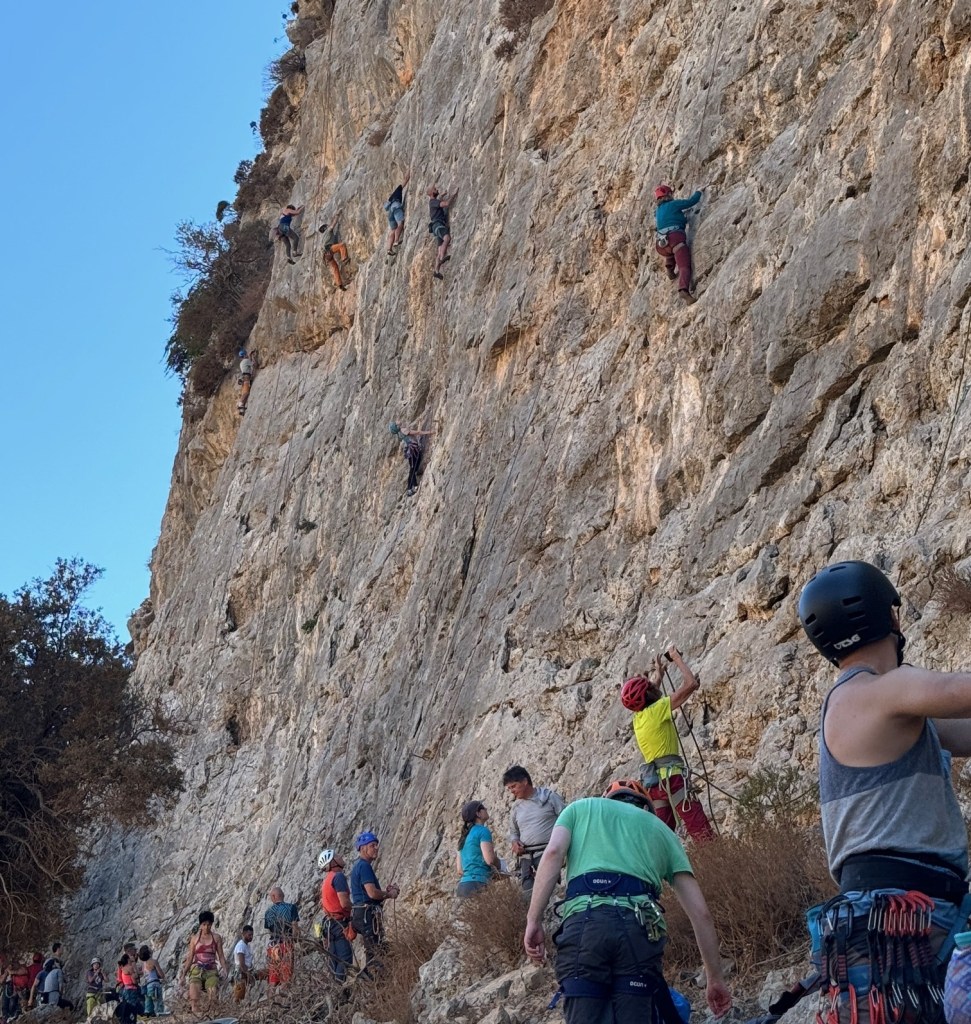

One of the busiest crags on the island and, on the right, the corresponding page from the guidebook. The limestone is so featured (unlike the clean sweeps of granite to be found on the Chief) that climbs can be every two meters. They’re all well bolted with great anchor systems at the top. They even had the route name and grade painted (discretely) at the bottom of each route. All very Euro. The busier walls, like this one, were a bit off-putting initially, but the climbers were accommodating and proximity made for great social connections. At this particular crag we had a fun encounter with two Scots who turned out to be old med school buddies of our doctor of the past 30 years! Over the weeks we had many lovely connections with other climbers from France, Canada, US, Germany, Switzerland, Britain, Italy, Slovenia, etc..
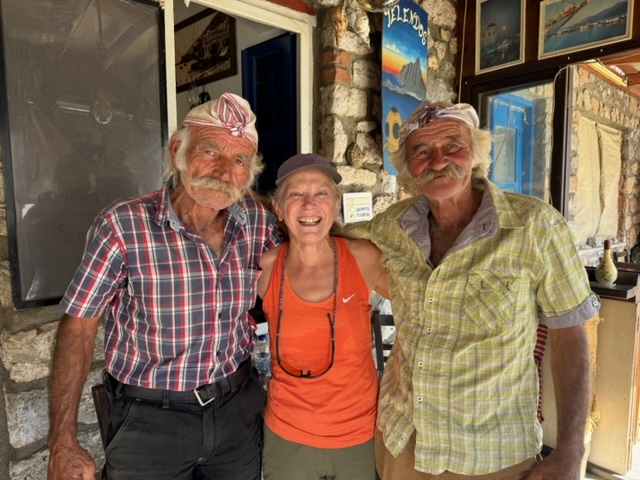
At a local taverna, Claire asked if she could take a photo of these two characters and they immediately responded with yes, as long as they could pay for our coffees. The Kalyminians were generous, kind and outgoing and reminded us of the warm reception we received in Greece when we biked the country nine years ago. We tried to reciprocate and bought their next round of ouzo.

Not sure what was the most common; locals, climbers, goats or feral cats. They were everywhere and clearly some locals feel it their duty to feed them. Efforts in the past to sterilize the population didn’t appear to be working. I think more drastic measures were in order, of which I’m sure the local songbirds were fully supportive.
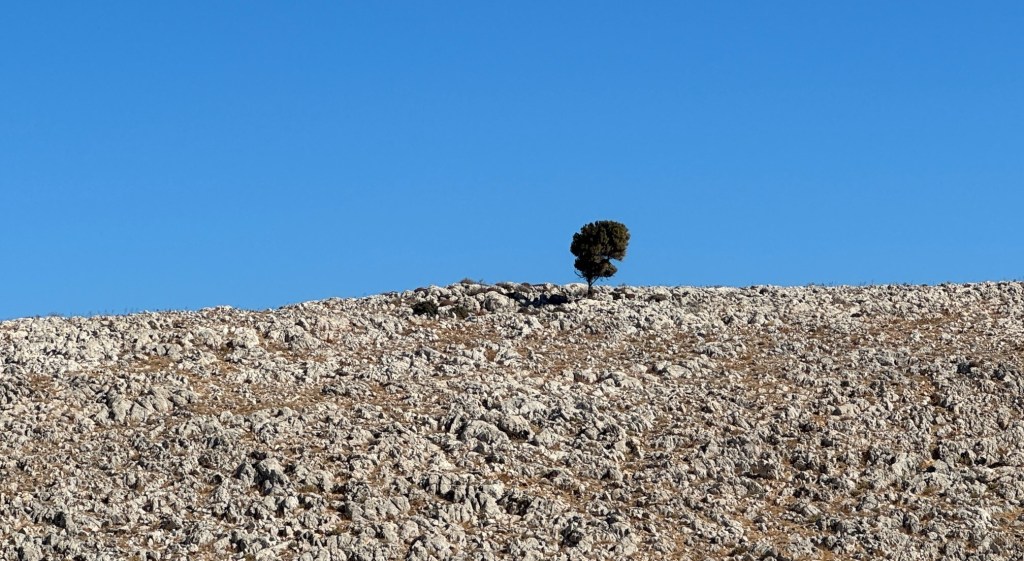
The unforgiving, rocky landscape of Kalymnos. Of course, it is also these same rocks that make it a climber’s paradise and now the prime driver of the local economy. The locals say “it’s hard to believe this curse – the rocks – was in fact a blessing in disguise!”

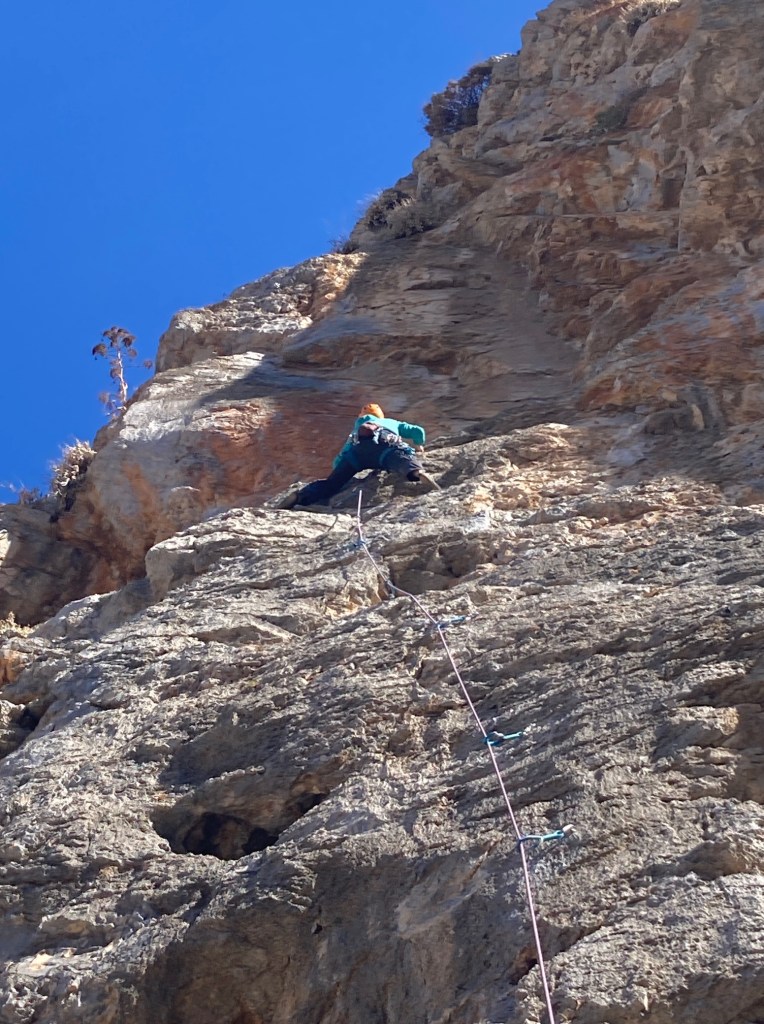
To the left, Claire leading an exposed traverse above a giant cave feature. The moves were well within her capabilities but ‘composure with exposure’ was essential, for which Claire is remarkably composed. On the right, I’m on a climb that was about to get significantly harder on the ‘smooth’ red wall above. I had had aspirations to ‘push my grades’ (climb more difficult routes) in Kalymnos. For the most part, common sense prevailed and I stayed within my limits however near the end of our stay I did manage to get up some routes graded 5.10b/c and with each successive day our confidence was growing. Pushing ones limits and taking falls is very much part of the sport but at the level we climb falls are much more impactful, i.e., lower angle, featured rock to fall on, so falling is not in the cards. In the course of our stay, we both had small falls but neither of any consequence.
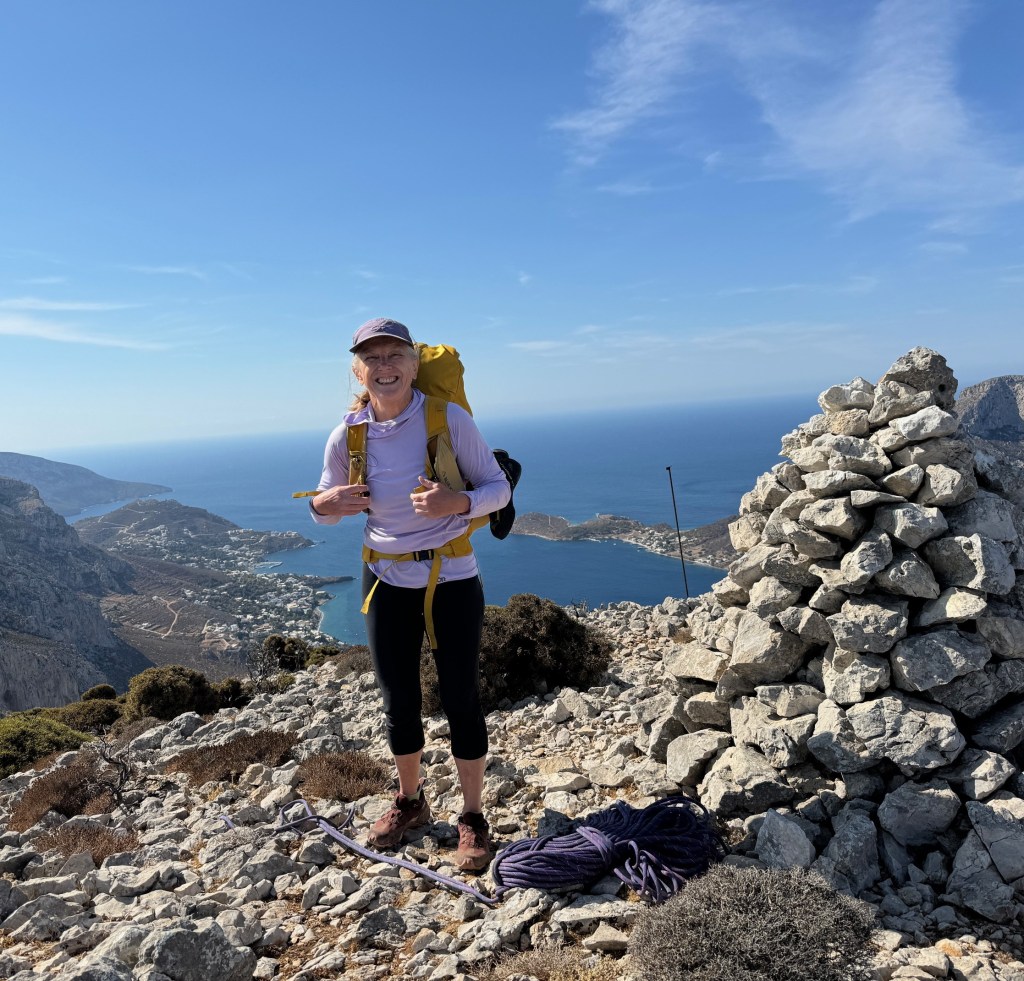

During our time on the island we managed to do four multi-pitch climbs, all well worthwhile. On the left, we’re just about to start our descent from Three Stripes (6 pitch, 5.10a). On the right, I’m belaying Claire up on the last pitch of Wings For Life (11 pitch, 5.10 b – only one, maybe two moves at that grade) on the island of Telendos. The picture was taken by a young couple from Revelstoke. They joined us for the two hour hike back to the tiny village and the small boat that would take us back to Kalymnos.
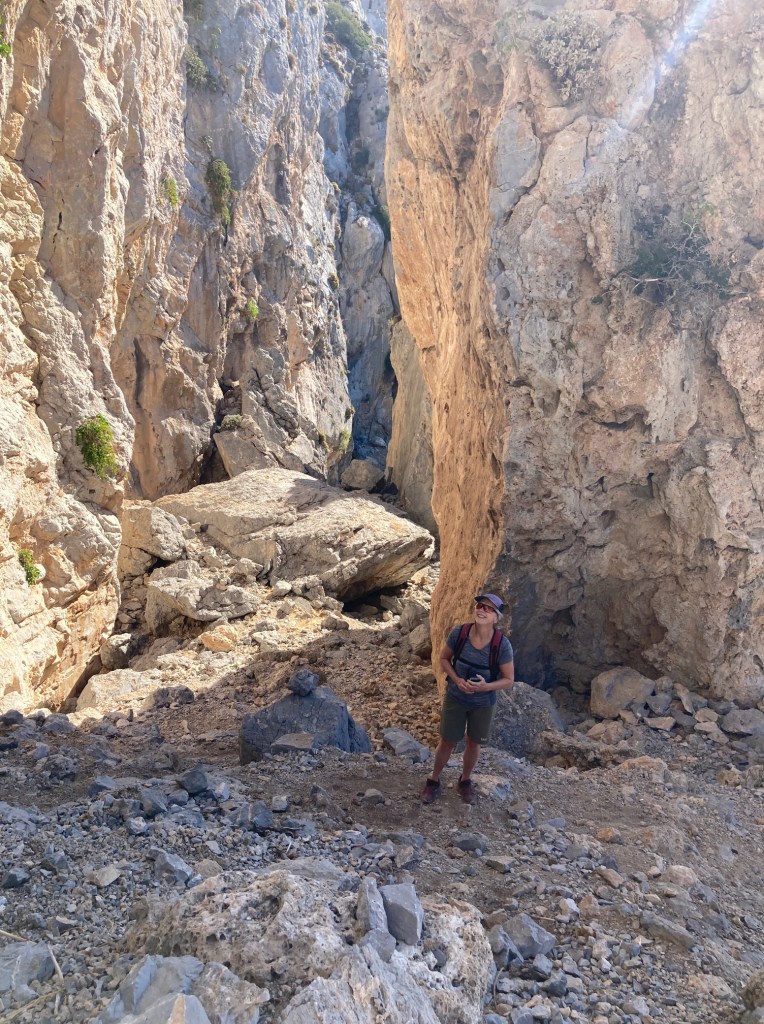

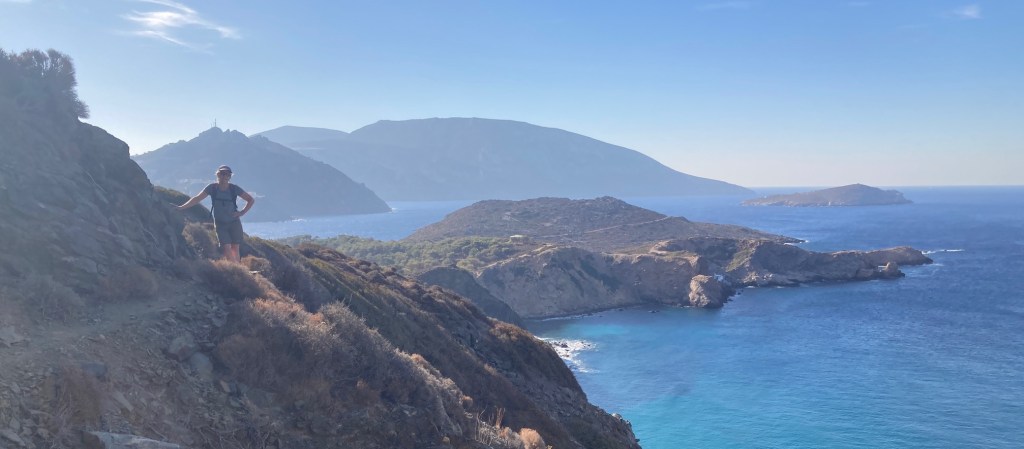
After three days of climbing our finger tips would be fried from the sharp limestone so every fourth day would be a ‘rest’ day. Claire’s idea of a rest day is a hike, which we did on four of our rest days. The above photos are from our 6 hour circumnavigation of the small island of Telendos, a couple of kms off the coast from the main island. The trail, marked by cairns, was progressively harder to follow until there were no more cairns, only vague goat paths. Figuring, if we continued, we only had only a few kilometers to meet up with the main trail and combined with the open sight lines and our trusty mapping app, how hard would it be to cut across the side of this mountain? Two hours later, after traversing endless, jagged rocks on steep slopes and avoiding every second bush covered in thorns, we can tell you. It was hard!

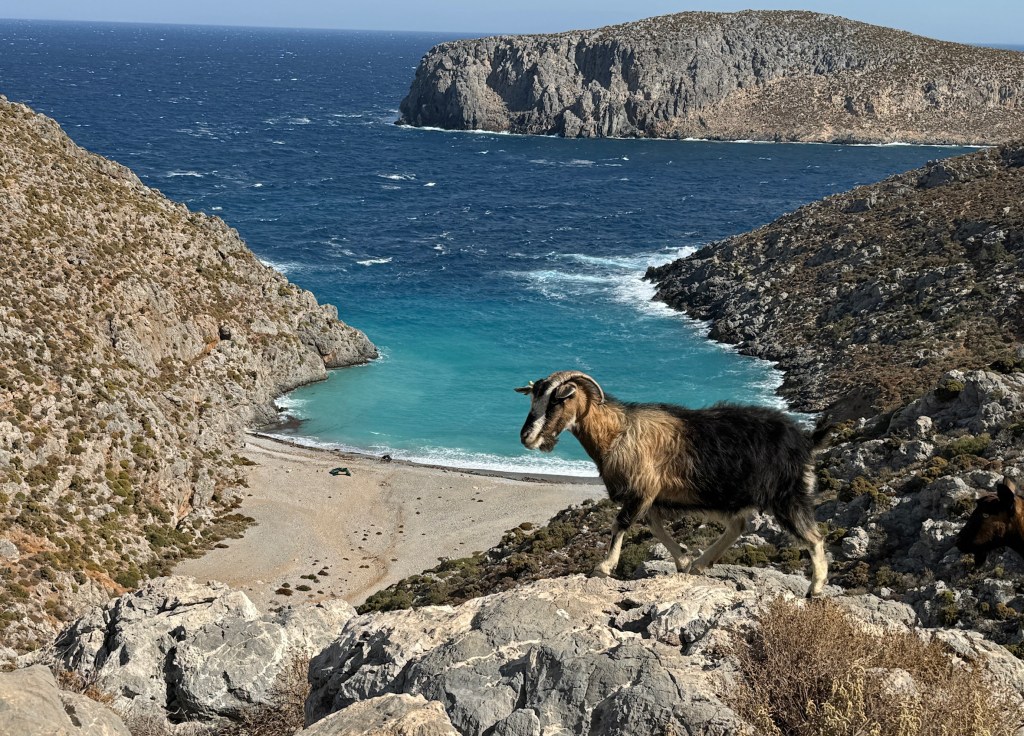

On another ‘rest’ day we hiked out to Sakati Cave, a giant hole in the ground that climbers would rappel down into. Most of the climbs were over our head (sic) so we hiked down to the beach (above left) immediately adjacent to the cave. Abandonned on the beach was this large, cheaply manufactured inflatable, now full of holes (purposefully cut to negate a return to sea?). The few cheap PDFs and inflated innertubes that littered the beach completed the story. The strong winds and waves just offshore brought home the risks refugees take in their crossings to an unknown future in the EU. Though refugees only occasionally land on Kalymnos, there are numerous Greek Islands closer to Turkey that have received many thousands more. The refugee situation remains a major issue in ‘frontline’ countries such as Greece. https://www.oxfam.org/en/stranded-greece-long-refugee-road-nowhere

The weather was perfect, maybe a little hot the first week or so, when climbing in the shade was the only option. We swam every day in the clear, blue Mediterranean waters (strangely devoid of life compared to our coastal waters) which was delightfully refreshing after the exertions of the day. Sunsets were consistently pretty special.

We were three pitches up on a climb when we noticed various goats perched precariously on the adjacent rock face. With no vegetation in sight nor local predators to avoid we had to wonder what induced them to climb so high. It turns out they are licking mineral salts!
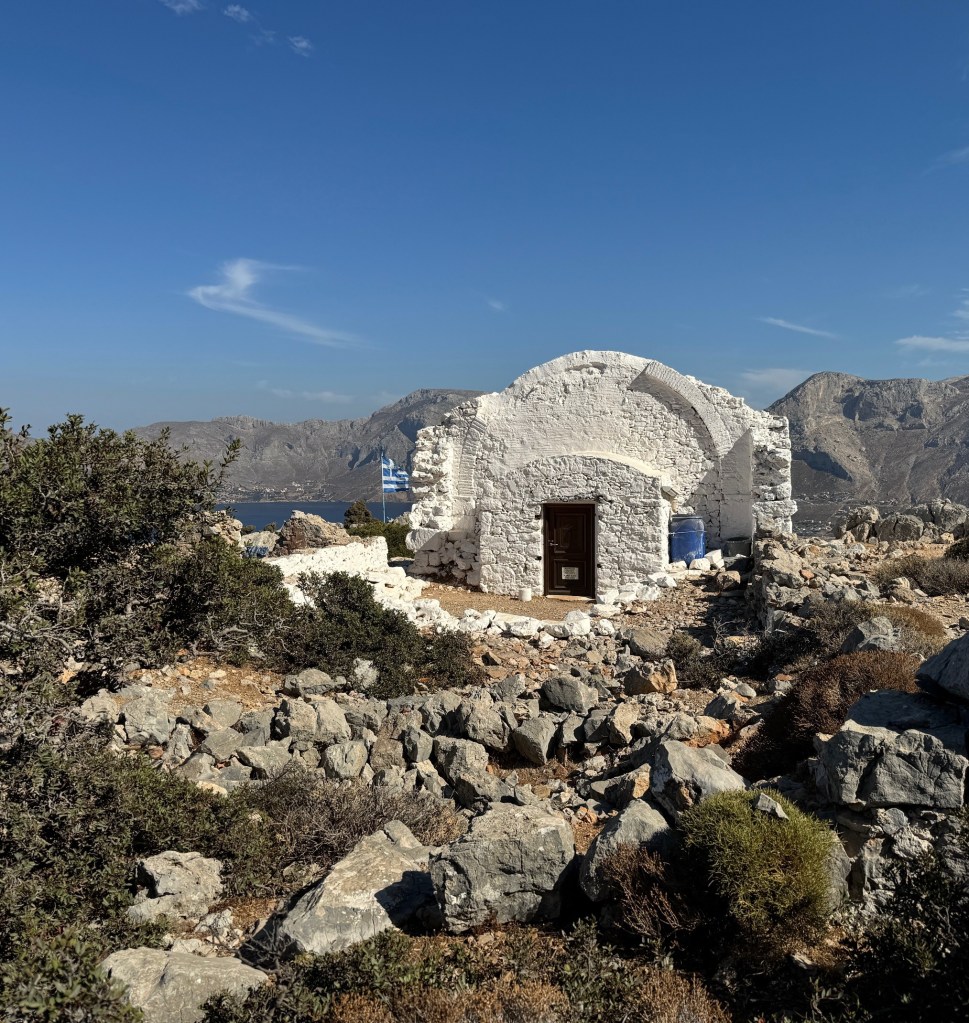
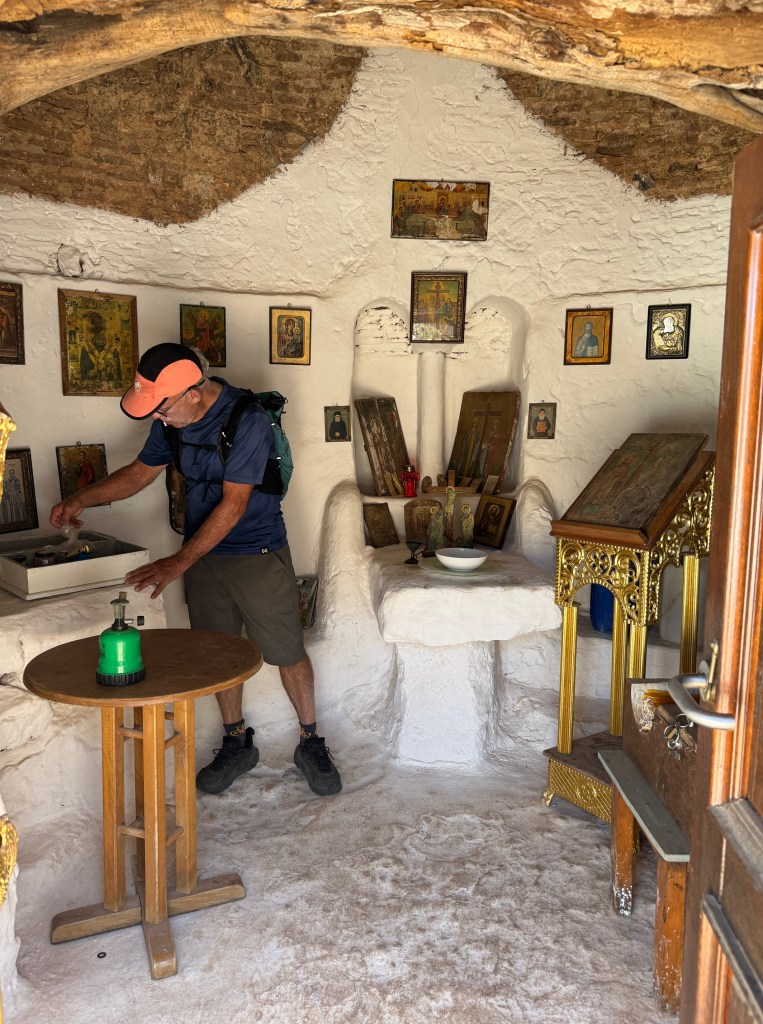
In often inhospitable locations, on top of hills, on uninhabited islands, half way up cliffs, etc., one finds these small chapels. They’re everywhere. Some in disrepair but many, like this chapel in the apse of the ruins of an ancient Byzantine church are lovingly taken care of, filled with religious icons. I was provided with various rationales for their unlikely sitings, none particularly convincing. Whatever the case may be, Eastern Orthodox Christianity is alive and well in Greece (90% of the population, state sanctioned and supported).
Despite how much we enjoyed our time on the island it is unlikely that we will ever return to Kalymnos for the simple reason that there are so many other places to explore. British Columbia alone offers a lifetime of climbing exploration. The US, of course, offers even more. Every time we travel to the US we are impressed by the beauty, the diversity and the accessibility of the the geography. On the other hand we also harbour unavoidable – and yes, irrational/unjustified – negative bias toward that portion of their population that voted for Trump, to the point where we wonder if we want to travel there!
So maybe Potrero Chico in Northern Mexico, or Sardinia, maybe Croatia….who knows? We are not ones for lounging poolside at fancy resorts. For us, travel requires a focus, typically in nature and climbing offers that and so much more! So, as long as we can manage the assorted aches and the pains that come with aging, we’ll persist. Tales for the future!
 OVER THE HILL AND BEYOND
Thank you for this fairy ta
LikeLike
What’s the 3rd arm you referenced? Is that a prusik connected to your harness so you can have both hands free if necessary? I’d like to read a comparison of the safety precautions you took back in the day vs the precautions everyone takes as a matter of course now. With pictures please!
LikeLike
A 3rd ‘hand’ is indeed a prusik attached to ones harness. In the old days, we just wrapped the rope around our leg a couple of times in order to go ‘hands free’. For awhile our ‘harness’ was a piece of 2″ webbing wrapped 4x around our waist – called a swami belt. A ridiculous setup but fashionable for awhile.
LikeLike
Try rock climbing in the Netherlands. You always reach the summit…………………!
Nico
LikeLike
Your comment inspired me to do a search about climbing in the Netherlands and, lo and behold, there were a bunch of pictures of buildings and other man-made structures that people climb on, but absolutely NO rock! There is also the Excalibur Climbing tower in Groningen, apparently the tallest free-standing climbing wall in the world! Looks cool.
LikeLike
When I was in Estonia in ’93, the local rock climbing spot was a stone tower that was more than 2 stories high!
LikeLike
Jim and Claire, you continue to inspire us with your adventures, although I think I’ve given up on trying to keep up with you! I’ll just continue to enjoy your fine story telling and I’ll look forward to hearing more of this and future trips. Thanks for the great post.
LikeLike
Good to hear from you Vicki. Claire is off in Nepal now but when home we’ll have to get together. She’s doing the Manaslu trek, which crosses a 5,200 M pass and has numerous long days. Fingers crossed that all goes well for the four of them – the two mother-daughter team!
LikeLike
Thanks for the chance to see and hear some of what you experienced on this amazing trip! I so admire your energy, drive and sense of adventure. Love sharing your trips from the comfort of home!
Arlene
LikeLike
As always, such a pleasure to hear from our wonderful neighbours.
LikeLike