
Note to reader: Claire just convinced me to abandon a much longer post describing the politics, history and economy of Albania, which I was sure everyone wanted to wade through. Oh well, next time.
What a wonderful reception to this country. We were greeted at the ferry (from Corfu) dock in Sarande, Albania by the father of Poema, the Quest student we act as host family for in Squamish. Poema’s family had done the 7 hour drive from Kosovo the day before to meet us, show us around town and help us settle in to their apartment (we ended up staying a much welcomed 3 nights) and then they turned around that same day and headed home. We felt honoured to be shown such consideration and hope that the Kazazi family will be able to attend Poema’s graduation in Squamish so that we can return the favour. Postscript: The Kazazi family did indeed come to Squamish 2 years later. It was our pleasure to host them.
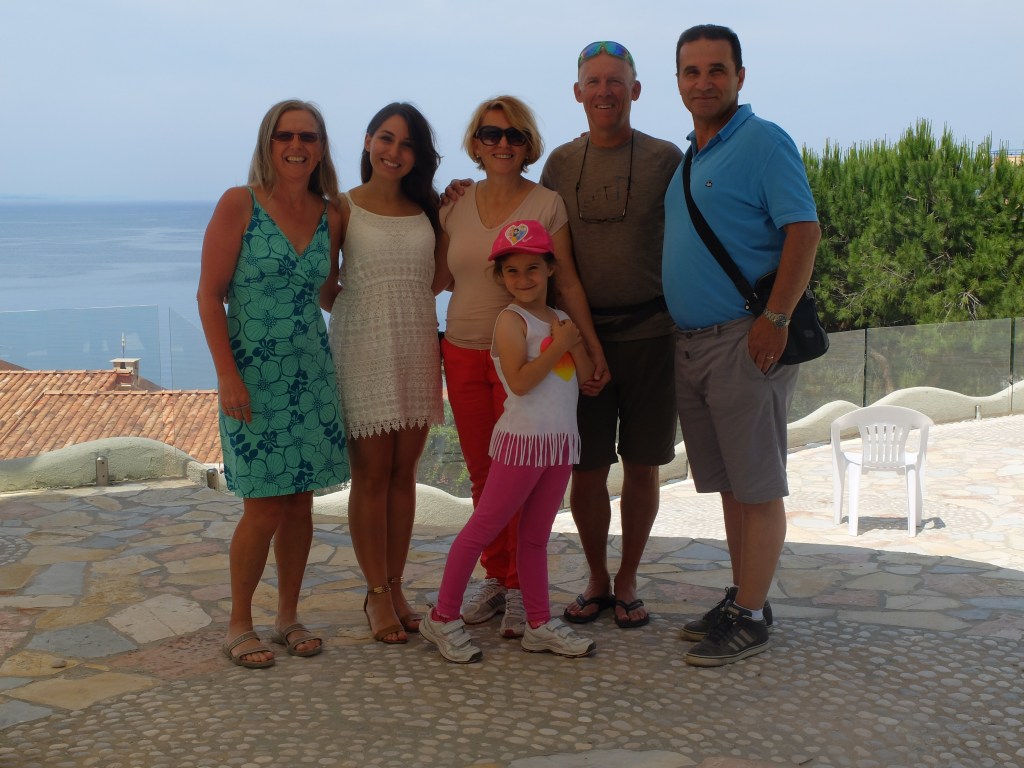
Albania has been a surprise in many ways. Like most North Americans I knew so little about the country but after 8 days touring the coast and 2 days in the mountains we’ve learnt a few things.
We found the Albanians almost universally patient, tolerant, easy-go-lucky (quick to laugh) and most importantly, adaptable. These attributes are all the more remarkable given the turmoil the country has been through. To read the history of Albania since independence in 1912 is to wonder at what holds this place together. Though we found most Albanians rather pessimistic for the future of their country they are nonetheless quite nationalistic and proud….something to do with, we believe, having to fight/suffer for what they have. I believe this nationalistic pride (at times strident) is common to many of the Balkan states.
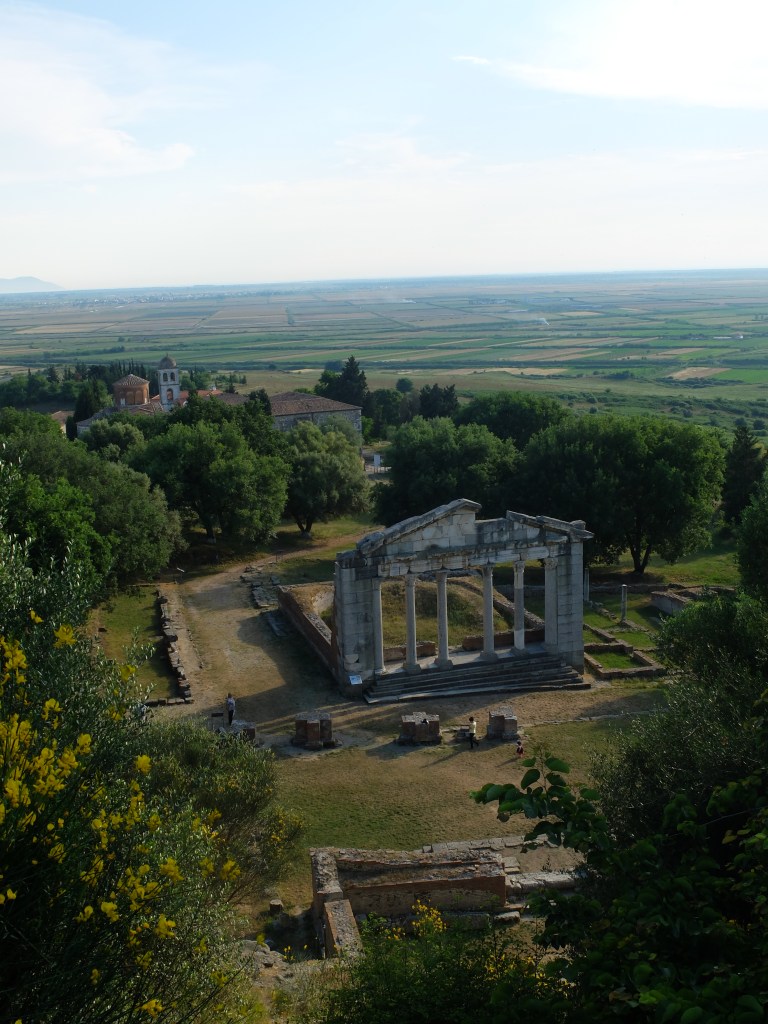
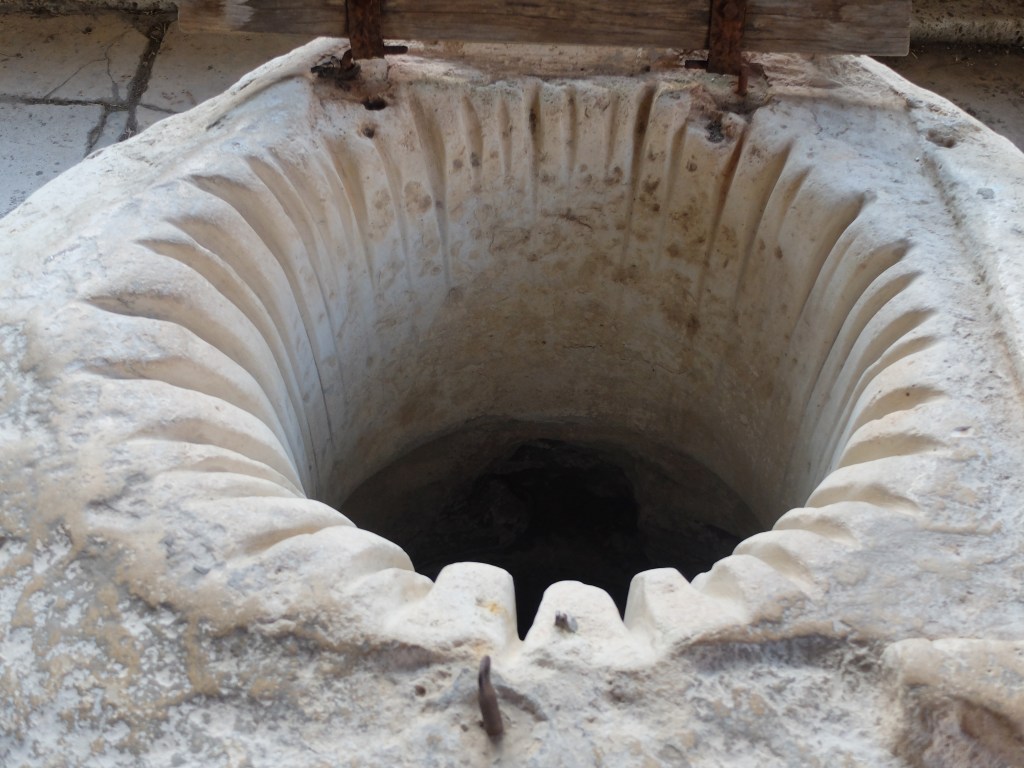
(Left) Roman ruins dotted the landscape but political isolation and a struggling economy made archeological preservation difficult. (Right) An ancient well. Imagine the years of use that resulted in such deep grooves in the limestone perimeter.
Though it is not something we experienced, corruption is apparently rife, money laundering a big problem and the upcoming elections are unlikely to be ‘free and fair’. I had also heard that as a result of the anarchy of the late 90’s, criminal gangs had taken hold. Witnessing three large groups of ‘full patch’ Hell’s Angels on Harleys roar past us, was testament to this or, at least, we assume it was. The bikers on their big and expensive hogs were a surreal sight…so unexpected. On the other hand, crime rates are significantly lower than the European average, other than the homicide rate, but more on this later.
In my previous post I had described our ‘idyllic’ first day of riding in Albania (decent road conditions, undulating hills, minimal traffic and respectful drivers) followed by a second day of serious hill climbing. The subsequent days of riding varied from a qualified ‘okay’ to rather nightmarish. Along the coast, most secondary roads are in very rough shape so we were generally restricted to the highways. Despite significant recent investment most highways had little if any shoulder. Where shoulders existed they were often used as another lane with traffic (typically scooters) in both directions! Lane demarcations were treated as vague distractions, manholes covers were typically missing and one-way signs were a hindrance to be ignored. One particularly tough stretch was when we got stuck on Albania’s version of the Autobahn for almost 15 kms in the afternoon heat with no way of getting off. We had to ride a narrow strip (50 cm wide) with speeding traffic on our left and gaping manholes without their covers (all stolen for scrap iron) to our right. It was intense! We finally humped our bikes over the fence and down a steep bank to escape. Note: Given the ‘unexpected’ nature of highway travel, Albanians are excellent at ‘sharing the road’. Montenegrins and Croatians, on the other hand, just honk and expect you to get out of the way!
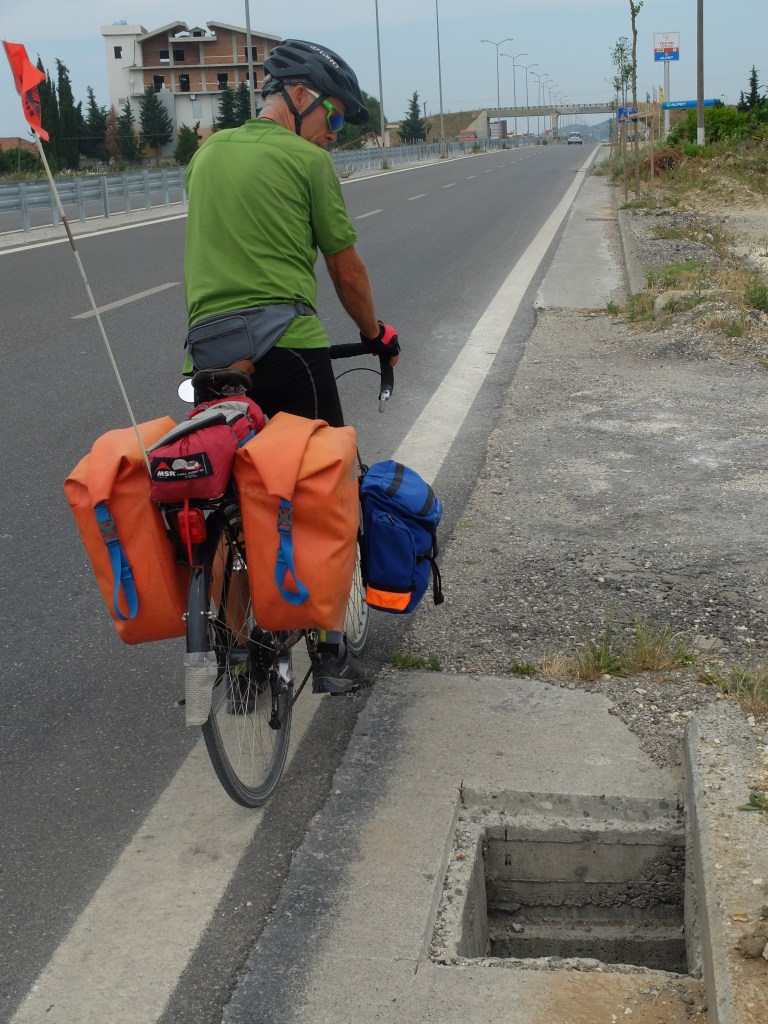
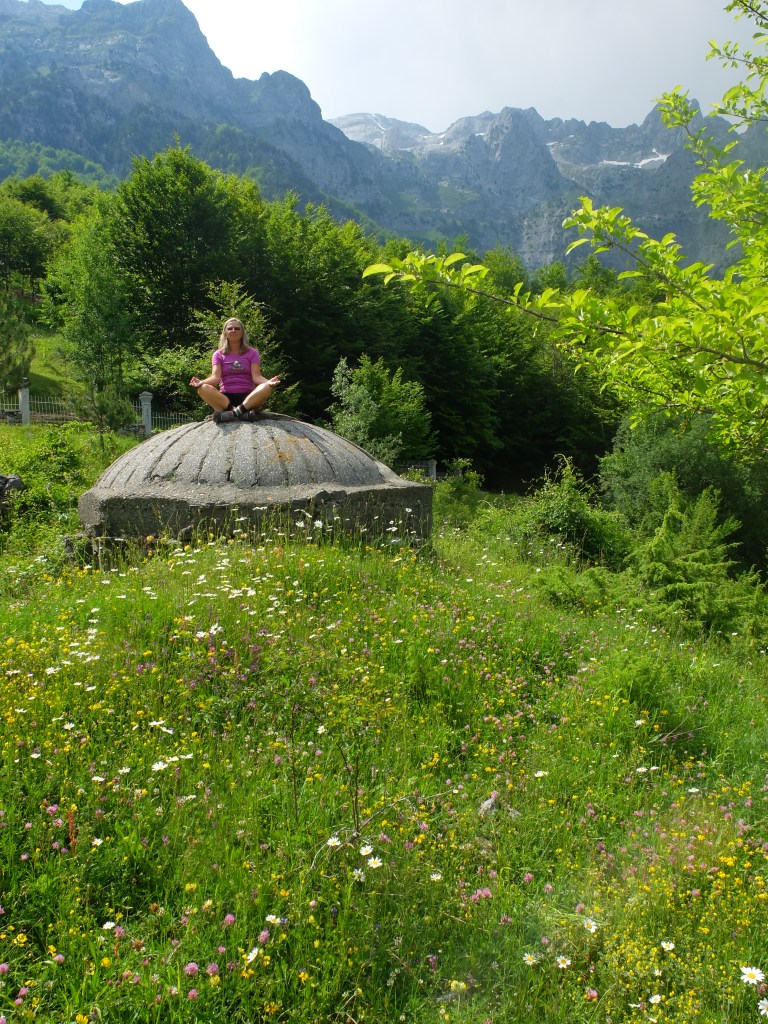
(Left) Two meter deep holes every 30 meters. It was a nerve-wracking ride! (Right)The paranoid dictator , Enver Hoxha built hundreds of thousands of these concrete bunkers. During his chaotic and oppressive reign Albania became known as the North Korea of Europe
After two nights at seaside towns known for their beaches (Durres & Shengjin) we were somewhat dismayed at how Albania is developing their tourism resource, the so called Albanian Riviera. Dramatic over-building of hotels & rental accommodation, with maybe 33% either unfinished or empty, all in the context of inadequate public infrastructure threatens to ruin the resource. In an environment of free-for-all capitalism, where property rights/land ownership are suspect, corruption is problematic and an enormous need and pent up demand for economic growth coupled with weak government institutions, well…shit happens. It is all so understandable and unfortunate. The Albanians deserve better.
On a whim we decided to tough it out on another stretch of Albanian highway and visit the historic town of Skoder before crossing into Montenegro, and we’re glad we did. Skoder turned out to be a lovely town and a bicycling paradise (it is all relative).


We stayed at a funky hostel on the outskirts of town and were talked into joining a group of high school students from the local Turkish International School on a two day trip into the iconic Albanian mountain town of Theth. The first night at the hostel was an odd cultural experience. A birthday party was being thrown in the garden by a young guy and he had hired the ‘best’ local rock band to play. In short, the band was really quite bad (though palatable when they played some Albanian rock). Nonetheless, the crowd seemed to think they were great! Conversely, I spent a good part of the evening chatting with a culturally sophisticated and well educated Albanian photographer. Somehow the two ‘experiences’ didn’t jibe. My cultural confusion was further complicated after listening to the great ‘play lists’ (our kind of music), of the young students on the bus trip in and out of Theth. The group of kids, all guys (it was a Turkish school after all), just graduated from Grade 11, really impressed us. Pleasant, well spoken, respectful, bright and a fun group to be with.
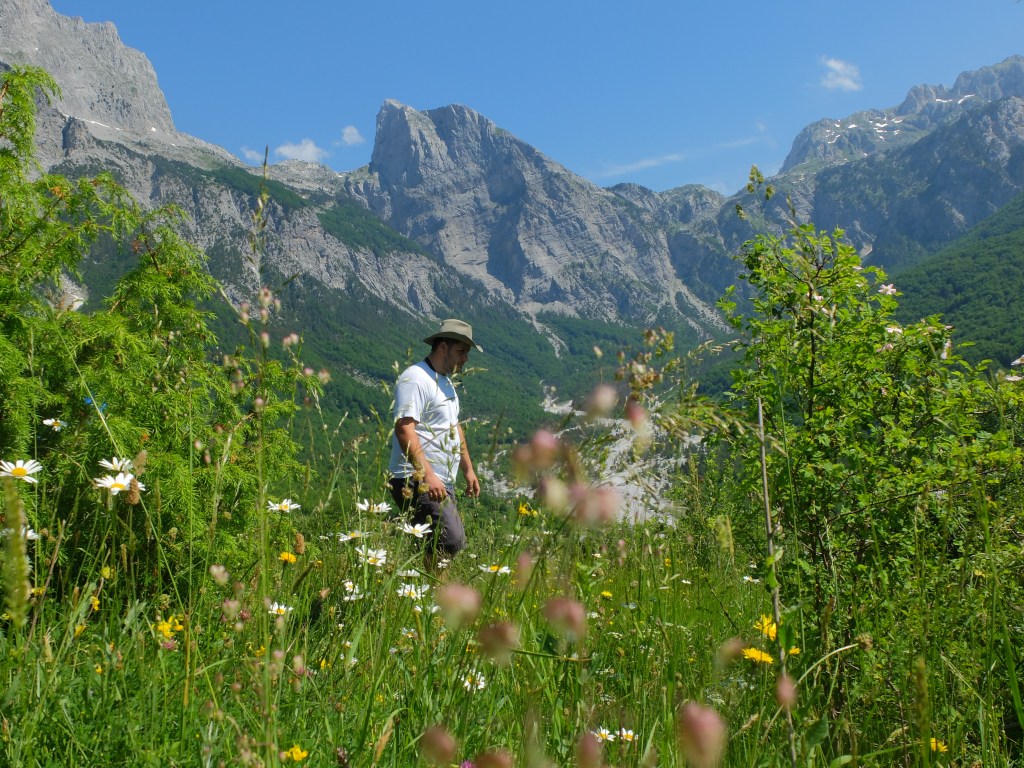
The 3.5 hour trip into Theth was quite something. After a long climb of tight switchbacks, the good, recently-asphalted, road abruptly stopped at the top of a 1600 M pass. We then began the interminably long descent down a very rough, single lane gravel road with precipitous, unprotected drops to our right (not for the faint of heart) into this spectacular valley surrounded by dramatic limestone peaks. We spent the night at our guides family home (12th generation in the valley) with all our meals, organic and traditional, prepared and served by his parents. It was simple but nourishing fare served ‘en plein air’. Both days we went on long hikes. The first day we visited the village proper. It was interesting, all very rustic but still a bit of a let down, with widely dispersed housing and a mish-mash of small tourism businesses dotted about. As we had seen in much of Albania, there was no evidence of planning, little government control and, in our opinion, little understanding of their potential tourism market. The highlight of the walk was coming upon the infamous ‘kulla’, a small fortress like structure where families would retreat to when ‘in blood’, i.e., were caught up in the lethal possibility of a revenge killing, a ‘blood feud’ that is apparently still commonplace in the highlands and explains the high rate of homicide. This phenomenon, all a bit hard to grasp, was totally out of keeping with the people we met. Our second day was spent hiking to a high mountain pass with 3 of the keener students (our rather, out of shape guide bailed half way up).
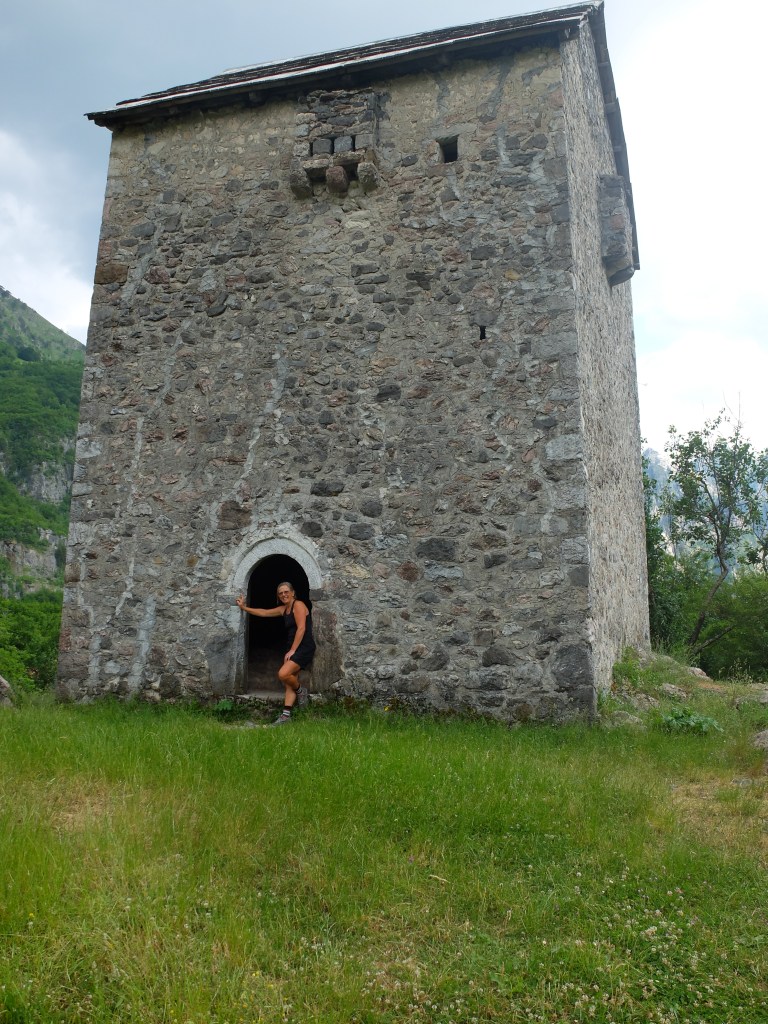

(Left) The ‘kulla’. A family refuge during a blood feud. (Right) A catacomb-like space below a Roman-era amphitheater in the city of Durres, only re-discovered in the 1960s. Regrettably, modern -era developments threaten it’s future survival.
The following day it was back on the bikes and the short ride to Montenegro.
So far this trip we’ve been able to avoid the big hill climbs but not this one. The first day riding north out of Sarande, Albania was, despite our fears, idyllic. There was zero shoulder but traffic was light, grades were very manageable and views awesome. Much to our surprise the Albania drivers were reasonably cautious and gave us a good berth. The country has a tradition of private car ownership going back only 25 years, so we expected far worse.
The next day, from the seaside town of Himare the road immediately shot up at an exhausting 15% grade. By the top of the initial stretch I was pushing my bike. Claire, with two additional gears was able to ride to the top. We continued along in this vein doing in total 600 M of climbing and then we came around the corner and saw the final 900 M climb. We felt reasonably strong going into it but I was totally bagged by the top. Just before the 2nd switchback I felt my first leg cramp coming on. Somehow I got to the top without a full on cramp setting in but I had to push the final leg.
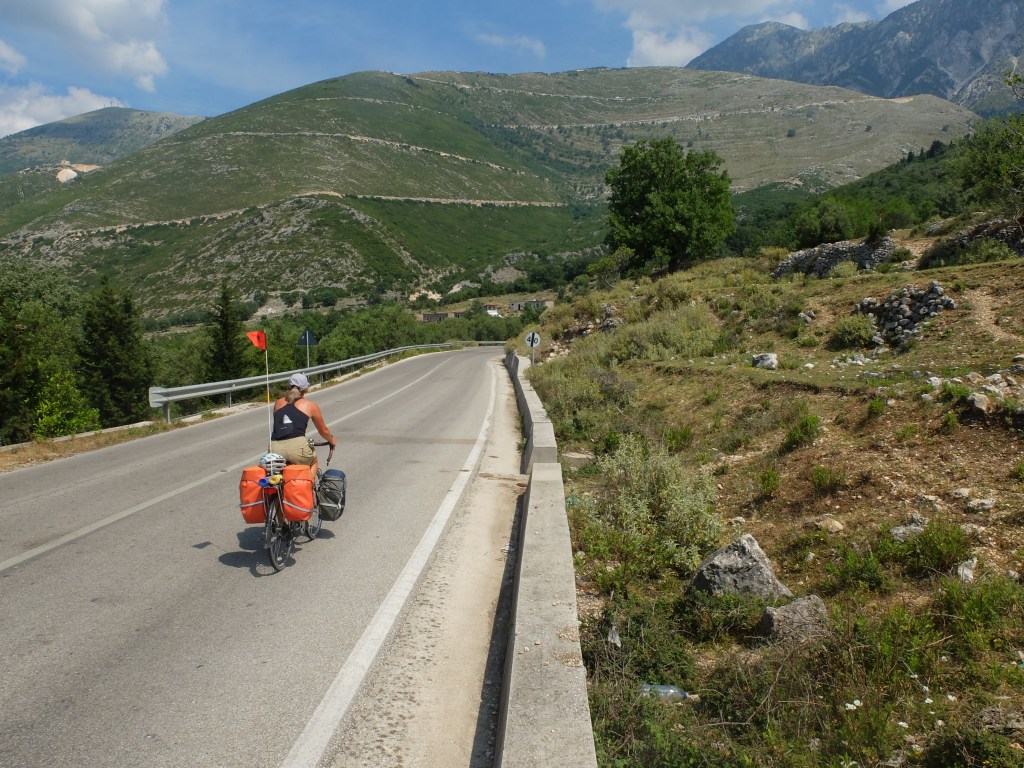
Though the ride back down to the coast was almost continuously downhill, the slightest uphill had me walking or I would go into a full blown cramping. The last 6 km had me spinning behind Claire as she ‘dragged’ me into town. A bit of a swim, lots of stretching and mutual leg massage and we can, we hope, ride this morning.
 OVER THE HILL AND BEYOND